The term “social determinants of health” is far more than a trendy new buzzword in health care. Serving the physical, mental and social needs of the community is not just the right thing to do but can mean substantial improvement in care and reduction in unnecessary healthcare costs.
Several studies have shown that addressing social needs, such as food or housing insecurity, can have a significant impact on a person’s healthcare outcomes and costs. Individuals experiencing housing insecurity or homelessness have higher rates of chronic diseases such as high blood pressure, heart disease, diabetes, asthma, chronic bronchitis, and HIV. This in turn leads to higher utilization of healthcare services such as emergency room visits, inpatient hospitalization and longer lengths of stay compared to those individuals with secure housing. Similar results are seen in those experiencing food insecurity.
Hospitals often state that part of their mission is to provide high quality care and improve the community’s health, or community benefit. A recent study of hospital mission statements in three states (Ohio, Florida and Texas) found that while quality was cited most often (65%), the second most frequently used term was community benefit (24%).[1] If community benefit or community health is part of your health system’s mission statement, how much are you really doing to address the whole health of a community vs. just addressing their “sickness” needs?
At PCCI, our combination of data scientists and expert clinicians believe that health systems have an obligation to address social determinants of health to ultimately remove the disparities and inequality that we see in our community’s health. Yet this is tricky because success requires outreach skills, community relationships and data insights that extend beyond the traditional promise of health-related services. That said, there are three key elements that can assist health systems in making an investment in social determinants of health a reality. To move from theory to action, my suggestion is that health systems do the following:
Leverage the board’s community presence to align on areas of greatest need
As part of health system leadership, board members ensure alignment between mission and a defined SDoH strategy at all levels of the organization. As community representatives themselves, board members can also create the momentum and connections that health systems need to bring community and business partners together to create a governance structure for launching a connected community of care. Such governance structure will guide the strategy, legal and policy needs, and the investment and execution of a connected and aligned SDoH strategy.
Invest in long-term partnerships to ensure sustainability
Recognize that as health systems, you alone cannot solve for social determinants. To truly meet the social, behavioral and emotional needs of some of the most vulnerable individuals in your community, you need to identify community partners with expertise in these areas. With the assistance of board members, assemble a partnership collaborative, with a formal governance structure, to build community-based strategies around SDoH needs. Support the sustainability of this collaborative with technology and data science techniques to identify specific root causes of social need in target populations, share data, and measure impact of interventions. Identify an independent partner to evaluate the effectively of the SDoH initiatives and measure the cost, savings and impact across the community and for the health system.
One of the many aspects that insurers focus on to create more value through their health plans is to improve communication with the members. In the era of growing digitization, most payers have started to offer online services. However, many beneficiaries still use traditional channels to interact with insurers.
Does it imply that members are averse to using digital channels for communication?
Absolutely not!
On the contrary, members are, in fact, more inclined to using digital channels than ever before. A survey revealed that 77 percent of consumers would like to pay their health insurance bills through an online portal. If members have the option to use digitized modes and they still continue to use the traditional modes, it clearly indicates there is a problem.
What prevents beneficiaries from using digital channels?
At this point in time, multinational giants such as Amazon and Google have made customers accustomed to unbeatable customized digital content. If members are still using old forms of communication, that is bad news for health plans. The probable reason behind this is unsynchronized information on offline and online channels.
Take an example of a member who has been communicating with their insurer through a call center and wants to shift to online communication. For that, they would have to share all their details on the new channel all over again, despite the fact that their information was already available to the insurer. This may lead to frustration because this interaction is neither convenient nor fast. As a result, they wouldn’t want to switch to a channel that makes the process more cumbersome than before.
The solution? Building omnichannel capabilities
For digital channels of communications to thrive and boost member experience, payers must work on developing omnichannel capabilities. Omnichannel communication can allow members to switch seamlessly between online and offline channels at their own convenience, without any additional steps. Even though most health plans offer digital communication, can only creating omnichannel communication maximize its value?
While working in the tech industry can be rewarding due to the creation & implementation of process improvement, it also can be a demanding and high-stress environment. Companies are beginning to take notice and are looking to avoid employee burnout and improve overall morale in order to increase not only productivity, but to decrease turnover and meet employee satisfaction. Whether you’re looking to change jobs, or finding ways to enhance management style, focusing on a few ways to reduce workplace stress can go a long way in the long-term care of your employees.
Focus on Mental Health
Whether it’s providing online or in-person counseling resources, therapy can provide an ongoing judgement-free discussion outside of work where you can open up and receive a care plan that meets your overall goals. Covered by your healthcare plan with a small co-pay due at visitation, employers that provide the needed tools for mental health improvement can find employees that are not only handling stress more efficiently, productivity will improve. Employees can find comfort that as these ongoing discussions occur, the work-life balance begins to take even more shape.
Promote Flexible Schedules
With burnout occurring with long, demanding hours in the office, not to mention the commute, many companies are choosing to promote flexible work schedules in order to reduce stress. Choosing your own start and stop hours as long as you meet the minimum required amount, whether it’s 8 or 10 hours, may make the difference if some days it helps to sleep in a little to rest for staying late the following day. In addition, allowing work from home can be refreshing, as you avoid the commute, attire, and break from other staff members, in the comfort of your own home office.
By Kali Durgampudi, chief technology, innovation officer, Greenway Health.
Kali Durgampudi
Like so many industries in today’s Third Industrial Revolution, the pace of innovation in healthcare today is fast and ever-changing. New technologies – like artificial intelligence (AI), machine learning, big data, the Internet of Things (IoT) and voice recognition – are at the heart of applications and tools that are becoming demanded by patients and more ingrained in clinicians’ daily workflows.
For vendors developing new solutions based on these technologies, it appears they find themselves in a ‘race,’ striving to be first-to-market in order to establish their competitive edge. But being on the bleeding edge of innovation isn’t always easy. The healthcare industry has not been immune to this rapid quest for first-mover advantage. Often when this occurs, these new solutions sacrifice the quality and functionality required to deliver on promised improvements.
Think about the initial introduction of the electronic health record (EHR). Billed as a way to make practices and physicians more efficient, many early EHR solutions had the opposite effect – creating a significant learning curve and adding to physicians’ workloads overall. While EHRs may have made great strides toward digitizing medical records, taking paper and manual processes out of the equation, they often created new problems that placed different burdens on practices, providers and patients. In fact, in the early days, physicians reported spending more than half of their workday – an average of six hours – using the EHR, plus another 86 minutes after hours.
But EHRs are not the only healthcare technology solution attributing to this challenge – it transcends innovation across the entire health IT sector. As an industry, we must take a step back and slowdown to ensure all new technology can deliver meaningful change to practices, providers and patients.
How to Design New Healthcare Technology with the End-User in Mind
A key to ensuring healthcare technology delivers true benefits is considering how it will fit into day-to-day operations of the end-user – whether that be a patient, a nurse, a surgeon or a billing manager. Before introducing any new technology to the market, make sure your first intention is to get it right.
To do that, engineering teams must employ “user-centered design,” a concept that emerged in the mid-1980s. This approach, defined by the International Standards Organization, “aims to make systems usable and useful by focusing on the users, their needs and requirements, and by applying human factors/ergonomics, usability knowledge and techniques.” The goal ultimately is to enhance effectiveness and efficiency, improve human well-being, user satisfaction, accessibility and sustainability, and to counteract possible adverse effects of use on human health, safety and performance.
User-centered design in healthcare could entail shadowing a nurse to observe his workflow when triaging patients, following a surgeon to see how she develops post-op papers, or interviewing patients to understand how they obtain healthcare information in their daily lives.
With that experience, you can then ascertain what capabilities would make users’ lives easier or more effective. From there, determine if there’s a way to improve an existing product on the market to fulfill needs, or whether a completely new platform is required.
Key Questions to Answer When Implementing a User-Centered Design Approach
There are several questions you must consider when following this method:
Over the past few years, there have been encouraging improvements in the realm of mental health care in the United States. Initiatives to improve mental health outcomes, such as the Affordable Care Act (2010), have been primarily aimed at requiring increased insurance coverage to encompass mental health services at levels comparable with physical medical care.
Despite these improvements, such policies do not address issues caused by access challenges within the referral system, and many of the one in five adults suffering from mental illness in the United States still are not accessing the mental health care they require and need. In particular, there exists a shortage of mental health providers across the country, and these health professionals are likely to be out-of-network for many patients. Further barriers preventing patients from obtaining care include travel, missed work time associated with appointments, and the social stigma of seeking mental health care.
Faced with these challenges, patients with mental health issues are resorting to emergency departments in search of mental health services. Hospital emergency departments lack access to psychiatric services and mental health resources. Further, as patients are improperly treated in urgent care settings, this can lead to reduced access to care for those with acute medical issues, which then results in poorer overall outcomes at the highest cost of care.
To address these multi-faceted challenges, value-based care models have placed particular importance on the role of primary care, as these organizations are uniquely positioned to promote innovation and efficiency through proactive and coordinated care. When it comes to mental health services, primary care providers (PCPs) serve at the front line of care and are positioned to be an excellent means of providing access to mental health care to a patient population in need. However, many PCPs lack adequate resources to treat these often complex and specialized issues.
Telehealth technologies, such as telepsychiatry and eConsults, can support primary care practices by creating networks to provide timely, documented, and standardized access to mental health professionals. This equips PCPs to more effectively manage patients with mental health concerns, reducing wait times and improving mental health outcomes.
AristaMD’s eConsult platform connects PCPs with adult and pediatric psychiatry, addiction medicine, and behavioral health specialists to provide care planning support and treatment recommendations. Ninety-one percent of AristaMD’s mental and behavioral health eConsults have been shown to include medication regimen guidance including initiation of treatments, diagnostic recommendations, and medication dosage adjustment, all of which can be managed within the primary care setting with the support of specialty insight.
By Aaron Perreira, director of integrated marketing, Kareo.
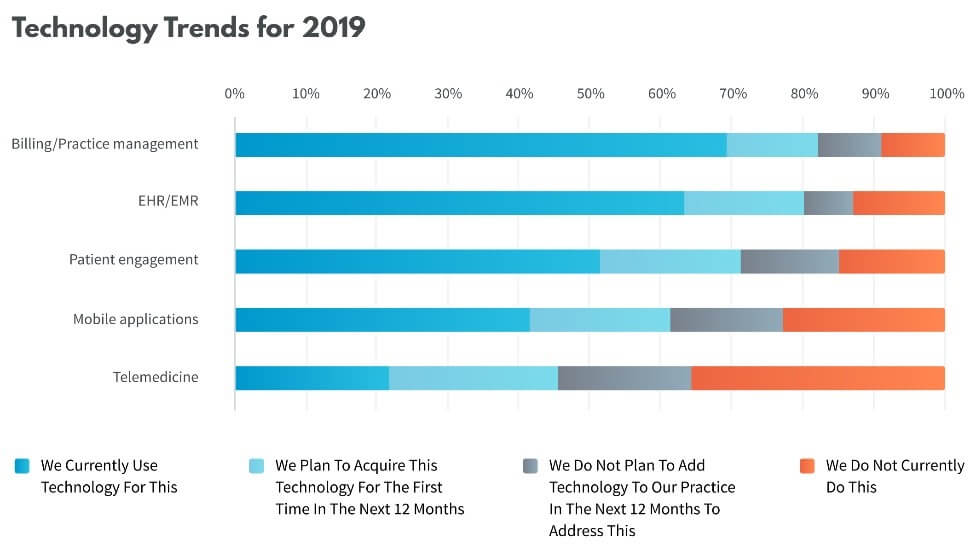
Over 70% of independent medical practices agree that the time demands of electronic health records (EHR) data entry detracts from care delivery. Simultaneously, 69% of independent practices state that integrated technology solutions are needed to improve the efficiency and profitability of their practices. This interesting “love/hate” relationship between independent practitioners and technology was shared in the recent 2019 State of the Independent Practice Industry Report, published by Kareo, a cloud-based medical software company.
The report was based on a nationwide survey designed to uncover the current challenges and expectations of independent practitioners in several areas of their practices, including care delivery, billing, patient engagement and regulatory compliance. Attitudes regarding the role of technology emerged in each of the areas surveyed.
Providers are increasingly reliant on their EHRs to manage their day-to-day clinical operations and maintain regulatory compliance. For many practices, the use of EHRs began when the Health Information Technology for Economic and Clinical Health (HITECH) Act of 2009 was signed into law by President Obama on February 17, 2009. The HITECH Act was created to motivate the implementation of electronic health records by providing monetary incentives for being able to demonstrate meaningful use of electronic health records.
At that time, the market was flooded with more than 700 EHR vendors looking to capitalize on the EHR gold rush. Many practices adopted EHRs at that time, however since then, as the regulatory standards and consumer requirements for EHR technology continued to evolve, an increasing number of software providers have failed to keep up with technology and have fallen out of the race. This has left many providers tethered to antiquated, ineffective systems. More established practices (in practice for 10 or more years) appear to be more gun shy in that they likely adopted their EHR several years ago and had to suffer through poor implementations of costly but under-performing software that didn’t deliver on the value that was promised.
Despite government mandate, penalties and incentives, only 64% of respondents are currently using an EHR today. This low figure likely represents both the entry of newer practices that haven’t yet implemented their EHR platform and the fact that some practice specialties such as mental health, are more likely to still be using paper-based records and haven’t made the switch to electronic records.
Patient care in the U.S. continues to modernize through rapid digitization, increasing connectivity among the internet of things (“IOT”). Supporting a robust infrastructure that allows for large scale flow of information through interconnected systems requires modernization of network technologies. One such technology advance is 5G.
5G is similar to its predecessor wireless technologies, such as 3G, 4G and LTE, but promises to have the capability to transmit 10 to 100 times more data than 4G in the same amount of time. 5G will also overcome issues related to latency, capacity, and customization that currently plague predecessor technologies. As the roll out of 5G progresses, the health industry is considering its potential impact of 5G on the healthcare ecosystem. Many believe that 5G will revolutionize healthcare delivery, and ultimately contribute to improved patient care. 5G appears poised to impact healthcare by facilitating faster and more seamless transmission of patient information at much larger volume than possible today. As such, 5G can improve patient care by facilitating Artificial Intelligence (“AI”), enabling remote care paradigms, and improving access to care.
Ebunola Aniyikaiye
One sector that will benefit from 5G’s ability to allow for fast and voluminous data transmission is AI. AI technologies are powered by algorithms that process complex and large data sets at exceptional speeds. With the arrival of 5G, health organizations may be better positioned to implement AI solutions directly into their delivery of care models. Advances in AI coupled with the power of 5G would foster care delivery that is data-rich and data-driven to improve quality of care and outcomes.
Additionally, adoption of 5G will likely increase access to high-quality care, by supporting remote care paradigms in the health industry. For example, remote radiological imaging and remote robotic surgery will likely thrive in the 5G world. The secure transport of extremely large, high-resolution image data is required for successful use of these technologies. The capacity of 5G to transmit these types of data at scale in a real-time or near-real time fashion will likely be transformative. Patients will be able to gain access to care from specialists they otherwise could not have had access to previously. For the same reasons, 5G will further untether providers from historical brick and mortar facilities such as hospitals and clinics.
By Eric Hamborg, co-founder and chief commercial officer, MOBE.
Last month, I was honored to join some of the country’s most elite healthcare executives at the Health Care Executive Group Annual Forum – a closed-door forum to engage in in-depth discussions about challenges and opportunities facing the healthcare industry today. It’s an event I look forward to every year as we discuss pressing issues and how we can better collaborate across the industry to drive meaningful change and innovation.
Each year, the event culminates with a Top 10 list of challenges, issues and opportunities that HCEG members and forum attendees are expecting to confront in the coming year. Over 100 execs from the country’s leading healthcare organizations all worked together to develop this predictive list – debating, ranking and voting on 25 topics compiled from webinars, round tables and the 2019 Industry Pulse Survey.
As a co-founder of MOBE, I could relate to many of the Top 10 issues – they’re the challenges we grapple with every day as we bridge the gap between lifestyle choices and medical care in order to support individuals in achieving their best health outcomes. While the full list included several important topics, there were a couple that continually came up in my conversations with other executives at HCEG, and seem to be particularly important as we consider the needs of today’s healthcare consumer and the industry’s future:
Cost and Transparency
Healthcare costs continue to soar and consume 15% to 20% of the U.S. GDP, so it’s not surprising to see “Cost & Transparency” ranked first on the Top 10 list for 2020. Anytime we discuss challenges or innovation in the healthcare space, cost will remain central to the conversation.
The U.S. has the highest unit costs for nearly all services and procedures – yet we’re not even in the top 10 countries for health outcomes. Why the disconnect? This is the point where healthcare executives, news outlets, and politicians might start pointing fingers at each other. However, HCEG proved to be a venue for diverse thoughts and provoking conversations, arriving together at the core of our most imperative issues and what it will take to pursue progress. In all of my conversations, one word continually came up: transparency.
Although transparency alone won’t solve our cost problems, it’s a key part of the solution. At MOBE, we’ve found this can be particularly powerful for individuals in a hidden population with high-deductible plans, who make up 15% to 20% of the healthcare spend within our clients’ commercially insured populations. Promoting transparency from all corners of the industry will help to equip the consumer with the information they need to make better healthcare decisions.
Holistic Individual Health
Most exciting to my colleagues and me was seeing holistic individual health make it on the top 10 – an encouraging signal that we are on the right path here at MOBE. Throughout the forum, healthcare executives repeated the need for identifying, addressing, and improving an individual’s overall well-being in order to promote a frictionless and connected healthcare experience.


 While working in the tech industry can be rewarding due to the creation & implementation of process improvement, it also can be a
 Providers are increasingly reliant on their EHRs to manage their day-to-day clinical operations and maintain regulatory compliance. For many practices, the use of EHRs began when the Health Information Technology for Economic and Clinical Health (HITECH) Act of 2009 was signed into law by President Obama on February 17, 2009. The HITECH Act was created to motivate the implementation of electronic health records by providing monetary incentives for being able to demonstrate meaningful use of electronic health records.

 Last month, I was honored to join some of the country’s most elite healthcare executives at the