By Chinmay Singh, co-founder and president, Asparia.
Chinmay Singh
Every medical group today is expected to demonstrate competence and results in population management. Increasingly, pay-for-performance contracts demand that groups utilize data, clinical coordination, and connected technology to improve patient care and patient outcomes. Information in the electronic health records (EHR) is often the glue that binds these initiatives together, enabling the dashboard for what individual patients need and a repository of data that can be analyzed for an entire group.
However, there is a notable gap in EHR capabilities that has been overlooked, up until now. The individual patient’s clinical data should be tapped and used to manage patients when they are not in the doctor’s office – to ensure adherence to manage treatment for chronic illness, for preventive tests and screenings, and for ongoing medical care.
Often called “patient access” functions, these communications today are fragmented, one-way, and for the most part, ineffective. How does the medical group notify the patients who need a particular vaccine? And how do they know that these patients may have actually received the vaccine elsewhere? What happens when preventive tests are due, and the patient doesn’t schedule or maybe doesn’t keep the appointment? What happens when patients are supposed to come back for a follow up in a year, and they don’t?
It’s not for lack of trying that these situations occur. Patient access departments use telephone calls, reminders by mail, e-mail and even texts, with no appreciable increase in consistency in the reduction of no-shows or patient compliance. Patients have good intentions of keeping their appointments, but life intervenes. It’s an inconvenience to them to have to call to re-schedule, and often they just let it go. Staff spending time calling each patient is tedious, time-consuming and expensive – and without a means to keep patients on track, quality of care suffers. Conditions that could have been detected early, may be only found when they are much more serious and expensive to treat. Illnesses that are preventable happen because the test or vaccine wasn’t received. The group’s costs of care go up, and outcomes go down.
Additionally, operational expenses rise. Staff time is wasted in trying to connect with patients by “old school” methods, and each no-show costs the office an average of $200. At a 7-20% no-show rate, a 100-provider health system has revenue leakage of about $10 million a year.
The solution is to adapt new technology like chatbots for example as a way to enable two-way automated communication with patients that taps the data in the EHR, and then communicates with the patient to ensure that the required actions are taken. Intelligent chatbots have modernized the doctor’s office and make convenience equal to that of dealing with the bank or online travel. This is what consumers expect today, and this is what they should be able to experience in health care.
Electronic health record companies such as Epic, NextGen, Athenahealth, AllScripts, Centricity, DrChrono and others have already incorporated these chatbots into their systems. Although awareness of this capability may be low, it is easy and inexpensive to integrate and use. This integration enables “zero friction” implementation and operations; staff do not have to undergo training to learn a new system and can continue to work within the EHR. With no data duplication, the EHR remains the single source of truth for patient data and interactions.
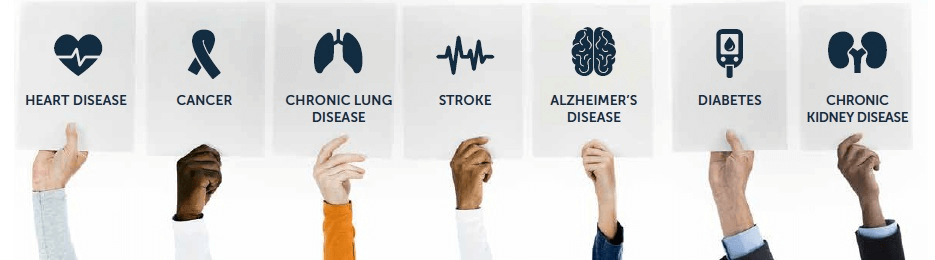
The provider community strives day and night to improve patient outcomes and contribute to the dream of value-based healthcare. However, the complexity of chronic diseases renders strategies ineffective and prevents them from reducing available utilization. In the US, chronic diseases account for 75 percent of all healthcare spending, to the tune of $3.5 trillion. In fact, every 6 out of 10 US adults is living with a chronic condition.
And, the costs are going to inflate in the future as well
By 2030, there will be more than 77 million+ people above 65 that necessitates Medicare coverage, which also calls for better chronic care management measures. If high-risk populations are identified now, the US healthcare can be better prepared to meet care expectations in the future and contain the costs for good. That said, a myopic approach to chronic care isn’t going to cut it. Let’s take a look at the loopholes in current chronic care management programs.
Pitfalls in Chronic Care Management
Fixation on short term goals
Effective chronic care management requires providers to focus on long-term well-being and stabilization needs of patients. However, the Affordable Care Act incentivizes providers for a reduction in 30-day re-admissions post-discharge. To witness a visible and landslide impact in chronic care management, providers must be looking for a mechanism that can track care management for high-risk patients beyond the 30-day readmission policy.
Less accommodation for comorbidities
Multiple chronic conditions have associated comorbidity that can increase the costs in the long run. Healthcare needs to inch to a robust system that takes into account the needs of comorbid patients. Mckinsey research suggests that 71% of patients with heart failure have hypertension, 37% have diabetes, and 53% have hyperlipidemia. These stats indicate that providers have the opportunity to go upstream and engage with these patients while they have a low-morbidity condition.
Inadequate risk stratification
Risk stratification is majorly centered on the needs of high-risk patients and often negates rising-risk patients. While preventive mechanisms for “high-risk” and “rising-risk” patients require a demarcation, specialty care and telehealth don’t promise a similar ROI for both patient pools. Aside from this, additional factors such as Social Determinants of Health are not an integral part of every risk stratification algorithm that results in skewed chronic care management plans.
Fragmented care delivery
A lack of coordination renders chronic care management ineffective and many a time, patients end up receiving clashing treatments that can lead to increased costs.
Primary care vs. specialty care
Primary care providers often face a hard time figuring out when a patient can be successfully managed in a primary care setting or qualifies to be under specialty care. Taking the right call between the two often becomes the reason for higher costs because of an increase in acute care utilization.
Senior living communities depend on human connection and care that serves each resident’s individual needs. But too often, a paper charting system gives way to inefficiencies such as medication mistakes, poor compliance, revenue leaks, and overall headaches for staff and administrators. As a result, senior living communities that rely on paper charts can’t always deliver the level of care they want to provide their residents. This can lead to dissatisfaction among residents.
And if residents are unhappy, community executives are unhappy.
That’s where electronic health records (EHR) come in. They eliminate the pain points of a manual documentation system and make it easier for staff and administrators to focus on the “why” of caring for residents by streamlining the “how.”
Here’s a look at the four main ways EHRs strengthen operational efficiency in senior living communities and enable excellent care for residents.
EHRs Improve Communications and Transparency
Senior living care hinges upon having access to accurate, up-to-date information about a resident’s health. For CNAs to deliver that care to residents, they need to communicate critical information smoothly and in a timely manner.
With a paper documentation system, it’s too easy for important details to get lost in the constant shuffle of folders and paperwork. Poor handwriting can cause confusion. If residents have incomplete clinical profiles, CNAs’ jobs are harder – there’s lots of back-and-forth with other CNAs and digging through file cabinets to find the information they’re looking for.
Compare that with EHRs: CNAs can use EHRs to efficiently record and access information about a resident’s health in real time, on cell phones, tablets, or computers. This information means CNAs can trust the EHR to correctly answer questions about a resident’s medication doses and clinical history.
Plus, long-term record keeping is critical in a senior living community with high staff turnover. EHRs make it easier to onboard new CNAs and help them quickly get acquainted with individual residents’ profiles.
But staff aren’t the only ones who benefit from enhanced communication through EHRs. A centralized and digitized record of contacts invites everyone to the conversation about a resident’s health.
If a resident visits the hospital, medical professionals can forward a hospital intelligence report to anticipate changes to resident services. This elevated communication between senior living communities and hospitals can improve health outcomes – research from the National Institutes of Health shows that EHR use in hospitals decreases readmission rates.
Family members at home want to stay in the loop on their loved ones’ health, too. EHRs can integrate clinical information into senior living family communication portals. That way, family members don’t just hear during visits or after an emergency – they can check in on their loved one’s health as often they please.
In the past, one of the appeals of becoming a doctor was the ability to maintain professional autonomy, with the hopes that this would also offer physicians flexibility and freedom in how they run their medical practices. Unfortunately, today the economic reality is that it will take well over six figures to establish a practice, on top of the average medical school debt accumulated of $150,000 to $200,000, makes creating a profitable traditional private practice a near economic impossibility.
Coworking spaces are not a novelty, and we’ve seen them sprawl nationwide across industries and cities as organizations and technology continue to fundamentally shift how and where we work. Coworking spaces are allowing people flexibility and autonomy and at a significantly reduced cost of running a business. Borrowing from this shared economy model, medical coworking is the disruptive concept needed to revive private practice, making the possibility of self-employment realistic once again by allowing start-up costs to drop from six figures to four, and by offering much needed support to physicians in operations, administration and marketing.
The biggest barrier to entry for a new doctor to start a practice has always been real estate overhead. With a shiny medical degree, but no active patients, doctors are asked to sign multi-year leases, without any promise of immediate or even short term returns on investment. Through my experience as a new physician, it took upwards of two years to establish a solid practice and patient-base, yet during that time I still had student debt and amounting rent and operational costs.
In the coworking model (as offered by Cowork Medical), doctors pay a monthly membership fee allowing them office access, front-desk support, group purchasing discounts and business consulting services. The membership fee gives physicians access to all coworking locations, meaning that a new doctor can have a multi-location practice instantly, giving that doctor the ability to grow a client base quicker and more cost-effectively than ever possible with a traditional model.
For many physicians, business mentorship is critical and the operational support provided by coworking concepts offers immense benefits to physicians entering the business, allowing them to put a stronger focus on their client care rather than dwell on tedious administrative tasks needed to make a business thrive. Doctors are taught to save lives, not how to run a business. Simply giving them an office space to settle in will not address all the vows of establishing and running a practice. Through strategic consulting, members are able to receive immediate access to decades of experience in practice management, learning how to operate and grow a successful practice in addition to strategic marketing tools at a minimal cost.
Today, the average cost of a healthcare data breach is $429 per record. When organizations factor in the loss of productivity, the amount of civil complaints and fines levied, plus the public relations besmirching, the cost implications skyrocket. In 2018, the Department of Health and Human Services Office of Civil Rights concluded a record year in HIPAA enforcement activity – 10 settlement cases and one judgment totaled a whopping $28.7 million.
Though every industry is susceptible to cyberattacks, healthcare has experienced the largest growth in attacks over the years because patient records, insurance information, and social security numbers are more valuable on the dark web. Unfortunately, legacy systems may to be blame for the uptick in cyberattacks. Forescout researchers determined 53% of common medical devices are still operating on traditional, legacy platforms.
Legacy systems, insufficient access controls, and the proliferation of medical IoT devices have created security vulnerabilities that leave hospitals wide open to cyberattacks. Research from Vectra found that the majority of legacy systems are unsecured because healthcare organizations simply can’t afford the amount of downtime that patching requires.
To guarantee that unstructured data is transmitted securely, healthcare organizations must extend their analog fax machines to a hybrid-cloud network that is HIPAA complaint and provides end-to-end encryption, two-factor authentication, and direct faxing capabilities.
Hybrid-Cloud Technology
By leveraging the cloud and delivering all faxes via HTTPS, outdated fax boards, media gateways, and the complex telephony stack are eliminated. Unlike a legacy analog fax infrastructure, hybrid cloud technology can ensure that time-sensitive protected health information (PHI) are delivered within seconds with high-resolution, near-diagnostic image quality, and the highest levels of encryption. The accessibility of fax, coupled with the scalability of the cloud, ensures the exchange of PHI among the healthcare ecosystem is protected. This allows patients to receive high-quality care without compromising their personal information.
By Marc Helberg, managing vice president at the Philadelphia office, Pariveda Solutions.
Marc Helberg
Data. It’s everywhere, and healthcare organizations know it can be theoretically useful in the modeling of predictive patient outcomes.
This sounds promising enough. But when we look beneath the surface, we learn that the industry as a whole has been relatively slow to adopt predictive analytics as a standard course of nonacademic care. In fact, just 34% of providers include it as part of their strategy.
This isn’t to say there aren’t plans for future applications. Providers recognize the potential for predictive analytics to improve outcomes and lower long-term costs. A Deloitte survey found that 84% of executives certainly see the benefits of predictive analytics in healthcare, as they say it will play a role in their organization’s strategy over the next three years.
So when will the role of data analytics in healthcare move from academic to more practical applications? And perhaps more importantly, what stops providers from taking action?
The Promise of Predictive Analytics
Some of the hesitation about analytics can be credited to misunderstandings about its scope. Given the hype — the market is expected to nearly quadruple in size to $8.46 billion by 2025, according to some estimates — many providers believe predictive analytics will make inherently disruptive changes to day-to-day operations. This includes supplanting sensitive tasks usually carried out by doctors (such as developing custom treatment plans).
In reality, analytics should focus on incremental improvements to allow doctors to do more of what they already do well. As it stands, six out of 10 physicians feel their time with patients is far too short to treat them effectively. The median time for visits is 11.8 minutes for patients in their 30s and rises to 14.3 minutes for patients who are 70 or older.
With predictive analytics, one possible initial deployment could assist with calendar management by using data on missed or canceled appointments to help doctors better estimate when they might have more time to handle complex patient visits. Small changes like this one could make a significant impact on patient experience.
Even if a provider is willing to invest in a larger-scope analytics project, its value will come in augmenting existing processes, not redoing them. In the near future, patient-generated data could help doctors assess and score the risk of an illness or disease in particular cases, but it will still require a doctor’s expertise to interpret the best way for the patient to address that risk.
When applied during care delivery, analytics could even factor in social and environmental conditions that could increase the likelihood of complications. That alone could reduce hospital re-admissions and improve the standard of care across the spectrum.
Again, this has nothing to do with a patient’s treatment plan. There will always be a need for human creativity in care that only a doctor or clinician can provide. Instead, the pros and cons of predictive analytics in healthcare can be better divided into high- and low-value applications. Data can excel in identifying health challenges, anticipating certain risk factors, and streamlining administrative tasks, which also provides an opportunity to further improve patient care.
Although barriers still prevent fully implementing predictive analytics in healthcare, leaders — especially those in information technology — can help break them down. Here are some of the best ways to start:
TigerConnect released its annual “State of Healthcare Communications” report, a survey of healthcare leaders and patients detailing the pervasive challenges in healthcare communications. The survey confirmed the fragmented state of communication in healthcare – with many organizations still heavily reliant on landline phones, fax machines, and pagers, and the adoption of modern communication technology often happening in silos.
Brad Brooks
“Adoption of modern communication solutions has occurred in every other industry but healthcare,” said Brad Brooks, chief executive officer and co-founder of TigerConnect. “Despite the fact that quality healthcare is vital to the well-being and functioning of a society, the shocking lack of communication innovation comes at a steep price, resulting in chronic delays, increased operational costs that are often passed down to the public, preventable medical errors, physician burnout, and in the worst cases, can even lead to death.”
In fact, industry research shows that communication inefficiencies cost a single 500-bed hospital more than $4 million annually (NCBI) and worst case, can lead to death, with communication breakdowns estimated to be a factor in 70% of medical error deaths (JMIR).
Our latest research sought to better understand the state of healthcare communication today and how technology solutions can foster better communication and collaboration in healthcare. Specifically, the survey found 90% of organizations are still using fax machines and 39% are still using pagers. Additionally, nearly 40% of healthcare professionals say that it is difficult to communicate with care team members, contributing to bottlenecks at various touchpoints when moving patients through the healthcare system.
Moreover, the majority of healthcare organizations – 52% – experience communication disconnects that impact patients daily or multiple times a week. It is also worth noting that non-clinical staff greatly underestimate the frequency of communication disconnects that impact patients. Clinical staff members were nearly three times more likely than non-clinical staff to say communication disconnects impact patients on a daily basis.
Survey findings include:
Communication in Healthcare is Broken:
The healthcare industry is still heavily reliant on 1970’s technology, with 89% using fax machines and 39% using pagers among some departments or roles, or even organization-wide.
Communication channels are badly fragmented in healthcare, with groups across the health system all using different tools to communicate.
Despite a growing mobile workforce in healthcare, landlines are still heavily relied on. Landline communication is the top choice of communication when secure messaging is not available – used 29% of the time. Among organizations using secure messaging it still ranks number two – used 25% of the time.
NextGen Healthcare, Inc. is acquiring Medfusion, Inc., a patient experience platform leader. The proposed acquisition is expected to close in early December 2019, subject to the satisfaction of closing conditions, including the transfer of Medfusion’s data services business out of Medfusion. The total purchase price of $43 million, subject to customary adjustments, will be paid in cash at acquisition completion.
Three powerful ambulatory care market trends make the acquisition of Medfusion a timely next step in NextGen Healthcare’s evolution:
As patients assume increased financial responsibility for their healthcare, they are more actively involved in making choices based on both cost and quality
High quality healthcare depends on improved access to care and information
Patient experience drives patient engagement which is key to improving health outcomes
Medfusion Patient Experience Platform enables key aspects of patient-provider interactions. It includes a modern portal with an attractive, easy-to-use interface designed to run on any device. The platform includes powerful capabilities for patient intake, patient scheduling and patient payment capabilities and is used by more than 16 million patients today.
Rusty Frantz
“We must further engage patients in their healthcare journey as engagement is essential for great outcomes and lowering the cost of care,” said Rusty Frantz, president and chief executive officer of NextGen Healthcare. “Providing the overall experience, tools and meaningful information isn’t just essential, it is increasingly expected by today’s healthcare consumer. The acquisition of Medfusion will add a best-in-class patient access and engagement capability to NextGen Healthcare’s award-winning, fully-integrated ambulatory platform.”
“From our founding, Medfusion has been focused on patient-provider communications and making health IT work for both patients and practices,” said Kim Labow, chief executive officer of Medfusion. “By joining forces with NextGen Healthcare, we will expand our market reach and accelerate NextGen’s mission of empowering the transformation of ambulatory care.”
Acquisition Terms
The acquisition agreement provides for the acquisition of all of the outstanding equity in Medfusion, but will be subject to Medfusion transferring, prior to the closing, its data services business, which is in its infancy and will be transferred out of Medfusion as Greenlight Health.

 Source: