By Ryan VanDePutte, associate director, Bits In Glass.
Ryan VanDePutte
Each day in the U.S., about 10,000 seniors turn 65. By 2050, there will be 83.7 million seniors in the country, representing about one-fifth of its population. Even with the growing awareness of health and fitness, it’s a hard reality that about three-quarters of these older Americans live with multiple chronic health conditions, ranging from diabetes to dementia, meaning that ongoing care and monitoring is simply a fact of life.
The way we deliver senior care has been evolving, and more patients are seeking to “age in place,” which means that they opt to remain in their own homes for as long as possible while receiving any necessary medical care.
This desire to remain at home is driven by many factors including a desire for comfort, access to friends and family, familiarity and privacy. Not to mention the economic benefits – with the cost of nursing homes easily topping $70,000 a year.
Because of this, home healthcare services have been growing in popularity, despite the fact that patients who receive care at home are more likely to experience a higher 30-day re-admission rate after leaving the hospital, compared to those in nursing homes. Still, the lower costs and comfort make home care an attractive option.
Your Doctor is Only as Good as the Information They Have
One challenge that home healthcare providers face is consistency in tracking and communicating information to the patient’s primary doctor. Not only information from care at home, but also information from clinics or hospital visits. This lack of insight into patient data can significantly increase the cost of care for patients because without access to the full history of the patient, unnecessary tests may be run, wasting both money and the doctor’s time. It is reported that a whopping $210 billion is spent annually on unnecessary medical care each year in America. Put in perspective, this is almost twice the U.S. 2019 federal education budget.
Further, there can be even more serious consequences to this lack of information and tracking. Without access to accurate patient records, medical errors are more likely because, for example, the patient may have an allergy unknown by the care provider. Medical errors are in fact the third leading cause of death in the U.S. Each year, approximately 250,000 patients in the U.S. die because of such errors.
As of 2017, nearly nine in 10 office-based physicians had implemented an electronic health record (EHR). Despite widespread adoption, a 2018 Quest Diagnostics survey was among the first to cast doubt on overall usefulness of “basic” EHRs. Only 39% of physicians surveyed believed their EHRs provided all the data and functionality needed to care for their patients.
Today, providers expect more than their EHRs alone can provide. They want relevant insights at the point of care that enhance interactions with patients and streamline practice operations. What’s more, they want this with minimal disruption to their existing workflow.
Lab data in the clinical setting
The 2018 Quest survey also showed that providers wanted easier access to lab data, and this isn’t integrated within most EHRs where it can be easily accessed prior to or during a patient visit. Improving access is critical since 72% of physicians said lab data informs many, if not most, clinical decisions. To overcome these limitations, some practices choose to implement separate systems, but working across applications that are poorly designed around practice workflow can consume valuable time.
Physicians want timely, accurate lab data to guide treatment plans. Today, it’s possible to see relevant lab data, including historic result trends, in one place, a few clicks away. When reviewed prior to or during a visit, this can prompt a discussion with the patient about progress or barriers to adherence at the most opportune moment, while it’s still possible to influence behavior and affect change.
Streamlining lab-related administrative tasks
In addition to providing clinically relevant insights that improve patient care, better access to lab ordering, results, and reimbursement can help practices streamline multiple touchpoints across the patient journey, positively affecting the patient experience and the practice bottom line. Reported benefits range from more efficient and reliable lab test ordering to improved billing accuracy and timeliness.
Hospitals and healthcare systems are benefitting from unprecedented innovation in information technology, helping improve everything from facility operations to patient care. But with these advancements come massive amounts of data—clinical research, digital imaging, and other patient data—that are taxing IT’s ability to cost-effectively manage and store in way that is secure, compliant, and always accessible.
Between the introduction of smart connected medical devices, plummeting costs of genome sequencing, and increasingly higher-resolution medical imaging, we are generating a wealth of information that is too expensive to store, yet too valuable—and, in many cases, unlawful—to throw away. Analysts from IDC predict that healthcare data will reach 2.3 zettabytes (ZB) by 2020. Imagine the discoveries that await, if only there was an affordable way to store it all.
Connected Medical Devices Mean Better Care, nd More Data To Store
According to the U.S. National Library of Medicine, within the next three years, 40% of the projected $117 billion IoT industry will be related to healthcare. The IoMT will generate exabytes of additional data, a portion of which compliance regulations will mandate you save. But what if we could store it all? What breakthroughs await when the power of analytics and machine learning are unleashed on vast archives of medical data?
The Internet of Medical Things (IoMT)
Real-time diagnostic data from connected medical equipment and home-health wearables promises to revolutionize medicine. Patients with long-term or chronic conditions can be monitored from the comfort of their homes. Instant access to information will speed diagnoses and response times. But perhaps the greatest potential of the Internet of Medical Things (IoMT) lies in the ability to save and analyze all the data these interconnected devices will generate over time.
Medical Imaging and Records
Hospitals and healthcare facilities are drowning in data as highly sensitive cameras, light wave and electron microscopy, and new modalities like 3D mammography and ultrasonic holography produce higher resolutions and larger file sizes. Many organizations adopt a “save everything” approach to ensure compliance with complicated regulations. To mitigate the high cost of storing all this data, complicated storage tiers and data lifecycle management solutions are implemented. But trying to figure out what doctors and researchers need access to on a regular basis and what can safely go into cold storage makes these complicated tiering strategies even more complex … and expensive.
Carrot Health, a provider of healthcare solutions powered by social determinants of health (SDoH), announced it has been named a finalist in the Accenture HealthTech Innovation Challenge – Health North America. Carrot Health was one of 13 companies to compete in the Boston regional round of the competition, which supports innovative technologies and drives creative solutions to improve the way people access and manage healthcare.
“We are honored to have advanced to the finals in this important program. Innovation is the engine that drives crucial improvements in healthcare, such as the ability to leverage key SDoH data to close critical care gaps by addressing the non-clinical needs that impact as much as 80% of health outcomes,” said Kurt Waltenbaugh, CEO of Carrot Health. “The caliber of technology solutions presented by our fellow competitors in the Boston round of the HealthTech Innovation Challenge was outstanding, and we are honored to have been among them.”
Carrot Health, which moves on to the finals taking place in Houston in February 2020, was selected for its Carrot MarketView platform, which generates insights for growth, quality and health using social, economic, behavioral and environmental data. MarketView helps healthcare organizations by leveraging consumer and clinical data to deliver a 360-degree view of the patient.
Validated in the market, Carrot Health’s predictive models and insights have proven effective at:
Driving growth by identifying consumer needs
Improving health outcomes by influencing key performance metrics, such as emergency department utilization, admission/readmission, cost of care and mortality
Enhancing quality by closing care gaps and improving customer satisfaction
“MarketView encourages health organizations to address appropriate needs along the full healthcare hierarchy, identifying and eliminating bottlenecks before they can adversely impact quality, care outcomes and costs,” said Waltenbaugh.
Since its inception, the Accenture HealthTech Innovation Challenge has brought healthcare organizations and startups together to tackle the world’s biggest health issues. Over the life of the program, Accenture has received more than 2,200 applications, invited more than 90 startups to compete, benefitted from the time and guidance of nearly 1,000 executive judges, and awarded 10 trophies to the most innovative healthcare startups. The Health North America challenge brought together innovative startups across North America to compete in a challenge focused on solutions in the areas of operational efficiency, increased access and consumer experience.
2020 predictions from Luma Health chief medical officer and co-founder, Dr. Tashfeen Ekram.
Dr. Tashfeen Ekram
As a country we’re expected to spend about $1.3 trillion for hospital care this year. With an average profit margin of 8%, hospitals have higher margins than the pharmacy or insurance industries. Patients are bearing the brunt of these rising costs and as a result, crowdsourcing sites have seen an influx of patients requiring help to pay their medical bills. Some patients are even avoiding the U.S. medical system all together as demonstrated by higher numbers of medical tourism to countries that provide cheaper access to surgeries and other procedures.
To mitigate inflated costs and retain patients, providers in the year to come will implement savvier solutions to reach patients, such as telehealth visits or new ways of engaging with patients across their care journey to help them stay on top of their health and wellbeing. We will also see an increasing variety of innovative payment and business models to balance cost and outcomes.
Amazon will help build the lingua franca for healthcare, unless CMS does it first
The pursuit to democratize access to health data across providers and patients alike remains a critical one. Only by breaking down the data silos that providers, devices and wearables build can EHR systems be gleaned for the treasure troves of insight and help provide increasingly personalized medicine for better clinical outcomes.
Amazon, Google, IBM, Microsoft, Oracle and Salesforce have pledged to open up interoperability via their involvement in FHIR, but this past year, CMS might have made the biggest move in interoperability by opening up an API for access to patient billing data. And when CMS decides on something, history shows that most will follow.
Retail clinics will improve access to care for patients, but quality remains uncertain
The thousands of retail clinics now providing patient care as a result of players like CVS, Walgreens and Walmart entering the healthcare market will improve care for millions of patients, who can now go across the street for easy access to basic healthcare services. To keep up with higher patient expectations around speed of access and convenience that consumerized access to care brings with it, providers across the board will turn to new solutions and partnerships to increase access and convenience, upping their game and retain the patients they risk losing to consumerized care.
By Khurram Mahmood, chief technology officer, Vineti.
Personalized cell and gene therapies are expanding the frontiers of medicine. In the past two years, the FDA approved two autologous cell and gene therapies, Kymriah and Yescarta. These made history as the first commercialized therapies developed for individual patients using genetic material from the patients themselves.
This specific type of cell and gene therapy (autologous) has a unique manufacturing process that varies from that of allogeneic or traditional treatments, which can both be produced in bulk.
Alongside inspiring hope for patients, the cell and gene therapies have introduced a slew of new logistical and manufacturing challenges. The logistics around manufacturing and transporting these therapies are so new and unique, the industry is still trying to grapple with the sheer complexity of the process. Manufacturing is still very manual as automated manufacturing systems are just beginning to emerge. See Cocoon Platform from Lonza as an example on such automated platform. For therapies in pre-commercial phases, clinical trial teams are adopting agile methodologies where they build continuous feedback loops and tweak their processes based on the results from different batches of patients.
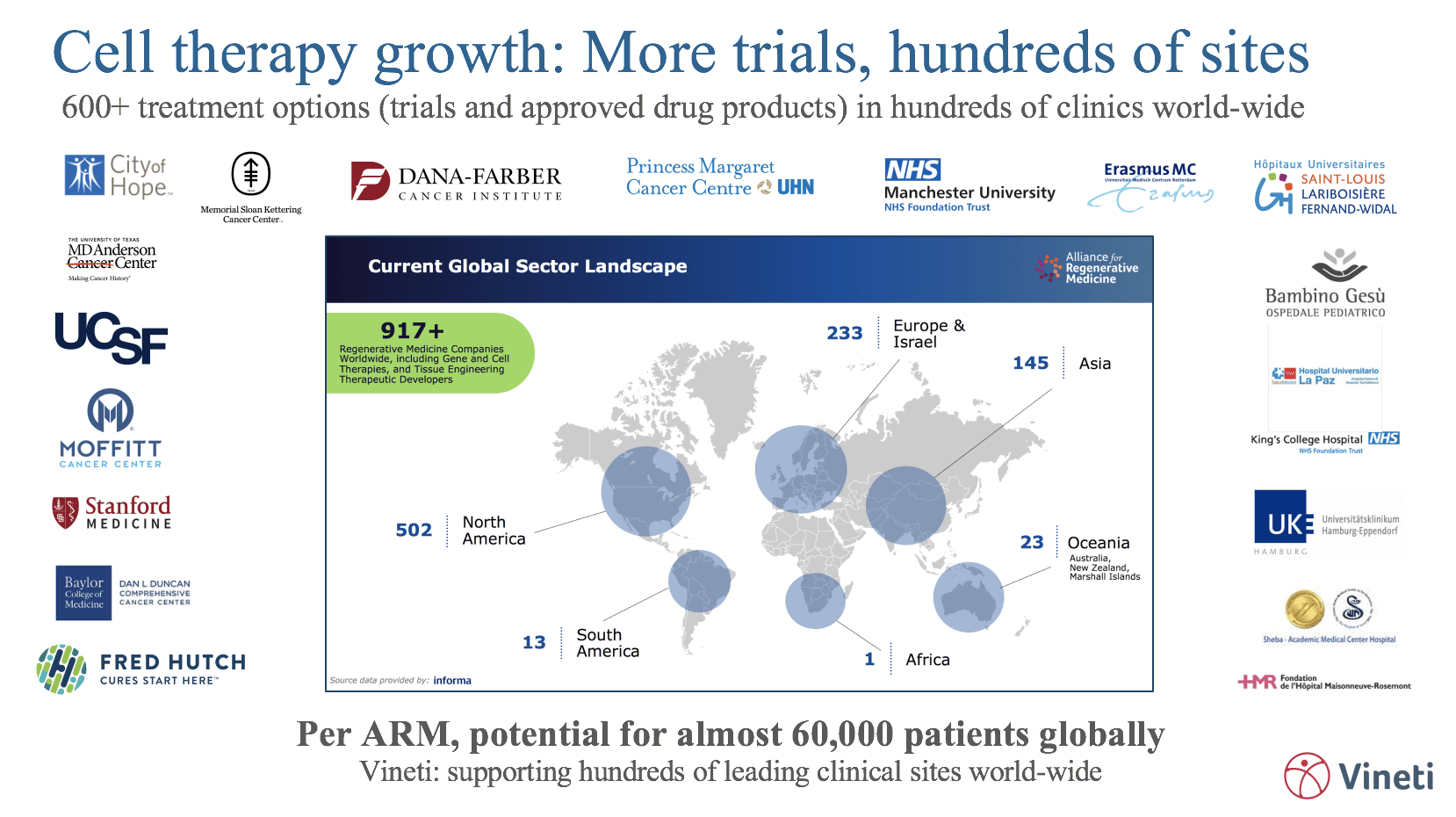
When a therapy is launched commercially, manufacturers have to on-board hundreds of hospital sites located across the globe, all with diverse IT systems and IT maturity, technology requirements, internal workflows, and national and regional regulations (which are constantly evolving). Many manufacturers are building geographically distributed facilities in an effort to more efficiently serve different regions, adding pressure to capacity management and routing capabilities.
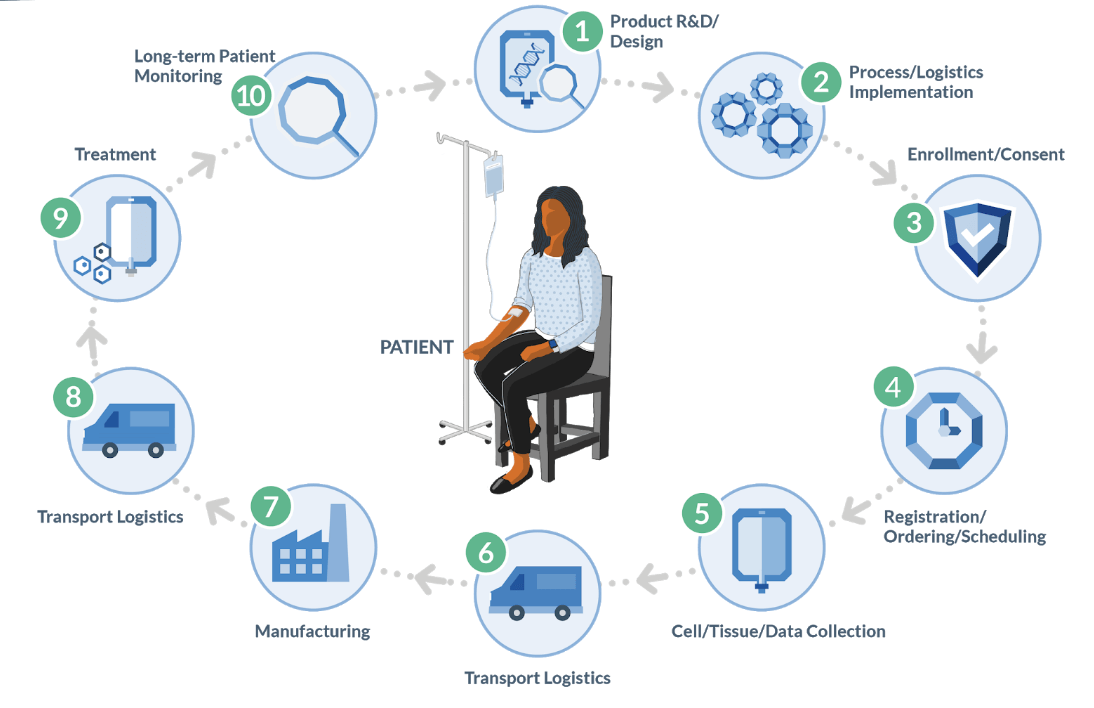
As depicted in the diagram above, the autologous process must begin at a GMP-certified collection site (most often a hospital or lab) to collect raw material (e.g. blood or tumor sample) from the patient. That is then transported to an external site to undergo a multi-step manufacturing process, creating the therapy that is then sent to an infusion site for administration to the original patient. Furthermore, the entire process is subject to timing and condition requirements.
In the paragraphs below, we describe a few key tenants that a platform must possess to be able to successfully orchestrate the personalized medicine supply chain. We focus primarily on the autologous cell and gene therapy but the general principles apply to all personalized medicine.
1. Common codebase and flexibility through configuration
A platform that uses the same code base among all customers and provides flexibility through configuration is by its very nature higher quality, more feature rich, flexible and faster to change than a bespoke application built specifically for one customer.
Higher quality because the same codebase processes all transactions and thus is rigorously pressure tested – a codebase that has processed hundreds of thousands of patients is always going to be more robust than the one processing its first patient.
Flexible because such a platform has to, by necessity, enable patterns and then allow for those patterns to be configured for several different use cases. As such it is not tied to one use case and can easily and quickly be re-configured to support other use cases as the market needs change.
By Justin Hunt, MD, MS, head of psychiatry, Ginger.
Justin Hunt
From banking to healthcare to grocery delivery—businesses and organizations across multiple industries are pivoting to leverage text messaging as a way to reach consumers. And in behavioral healthcare, text-based coaching is paving the way for increased access to support. Traditionally, mental healthcare providers have only offered in-person appointments for individuals seeking care. Today, virtual services like teletherapy and telepsychiatry are gradually growing in popularity among an increasingly tech-savvy population. Now, services like text-based behavioral health coaching offer another meaningful way for individuals to get in-the-moment care.
Consumer Expectations Have Shifted
Consumers today expect instant access to mobile-first, on-demand services. A recent survey by the Harris Poll on behalf of Ginger revealed that Americans–especially Millennials–are more comfortable with the idea of being able to text for mental health support as a way to get access to care. Two-thirds of Americans (66%) say that if they were struggling with stress or life challenges, they would prefer to text immediately with a certified mental health coach who is trained to provide support if given the choice, while 34 percent would choose to wait three weeks to meet with a licensed therapist in person. This trend is strongest with the Millennial population: 69 percent would prefer to text immediately with a professional rather than wait to meet in-person.
For many consumers, a chat-based solution may be less intimidating as a first step than going in-person to see a licensed professional. Coaching is emerging as a way for individuals to access support in overcoming day-to-day challenges, reach goals, and learn skills to reduce stress. While not licensed like a traditional provider, coaches do have credentials like coaching certifications or master’s- and doctoral-level backgrounds in mental and behavioral health. And just this year, the American Medical Association approved new codes for health and well-being coaching. Individuals can work with coaches alongside a therapist and psychiatrist to receive support between appointments and sustain the progress they’re making toward personal growth. Coaching is also effective as a preventative layer of mental healthcare. At Ginger, 68 percent of our members are non-severe and don’t require intensive therapy or medication management.
Text-based Chat is the New Normal
The younger generations that are digital natives have grown up with texting and chatting online as a regular, highly expressive form of communication. It comes as no surprise that they would be comfortable expressing themselves in this way to mental healthcare providers. For them, text-based chat with a coach can help them find meaning and healing. Additionally, both therapy and psychiatry are episodic in nature—with clinicians meeting clients bi-weekly or monthly. But as I’ve found in my work as a psychiatrist, life does not operate on that schedule.
While clients might demonstrate an overall trajectory of improvement, unexpected mini-crises in between appointments can slow down improvement. Immediate coaching intervention at the exact time of need helps to address these natural setbacks that occur between therapy or psychiatry visits. In addition to handling acute issues, coaching can offer a helpful longitudinal approach to goal setting. For example, coaches can check in with clients between clinical visits and remind them of healthy sleep hygiene techniques or provide light motivational interviewing to help an individual reduce alcohol consumption.
Scaling Care to Meet Demand
As mental health stigma decreases, more people are actively seeking services. Earlier this year, in partnership with Dimensional Research, Ginger surveyed more than 1,200 U.S. workers and found that a growing number of workers are proactively seeking out mental healthcare. Fifty percent of workers said they are more likely to seek help now than they were five years ago and 85 percent reported that behavioral health benefits are important when evaluating a new job.
There’s no getting around it: prescription drugs are expensive. In fact, if you have a lousy insurance policy, you could end up paying thousands of dollars out-of-pocket just to get your hands on the medications that you need.
Are you in this position? Wondering how to soften the blow? There are a few different ways to save on prescription costs, all of which we’ll discuss in this article.
Opt for Generics
In general, there are two types of prescription drugs: Name-brand drugs and generic drugs. When it comes to cost, it’s not even close: generic drugs are substantially cheaper than name-brand drugs. In fact, in most cases, generic versions are around 80% to 85% cheaper than name-brand versions.
Of course, this means that generic drugs are of lower quality than name-brand drugs, right? Not at all, actually.
In fact, in the vast majority of cases, name-brand drugs and their generic equivalents share exact ingredients. As such, there’s really no reason to ever opt for name-brands.
So, when your doctor is writing you up a prescription, be sure to ask if there’s a generic version available. If there is, your doctor will be glad to write it up for you.
Make Use of Assistance Programs
Another way to save money on prescriptions is to make use of assistance programs. There are quite a few assistance programs available in the United States, some of which can help you save as much as hundreds of dollars a month.
First, look to your state and local governments. Most states provide specialized assistance programs, as well as a program called Medicare Extra Help. The latter is beneficial to those on Medicare.
Next, you should look for non-profit assistance programs. Some popular ones include Partnership for Prescription Assistance and Needy Meds. You might be able to find others by searching for “non-profit prescription assistance” in Google or another search engine.



 “We are honored to have advanced to the finals in this important program. Innovation is the engine that drives crucial improvements in healthcare, such as the ability to leverage key SDoH data to close critical care gaps by addressing the non-clinical needs that impact as much as 80% of health outcomes,” said Kurt Waltenbaugh, CEO of Carrot Health. “The caliber of technology solutions presented by our fellow competitors in the Boston round of the HealthTech Innovation Challenge was outstanding, and we are honored to have been among them.”