Data center infrastructure management (DCIM) tools gather control, monitoring and allocation of assets, space, power, cabling, cooling and downtime in one place. This makes it much simpler to get and keep your arms around your facility. That is, assuming you know what functionalities are important for DCIM solutions when you acquire yours.
The right software will make it easier to trace and resolve cable and circuit outages. Integration of new equipment and maximization of old equipment can be accomplished more readily — even while power capacity is being optimized. And, best of all, you’ll have a clear picture of all of your center’s assets.
Given the proliferation of hackers taking control of systems and ransoming it back, one of your first concerns should always be access control. Keep in mind this applies to physical access to your server room as well. However, on the software side, you want a solution that gives you strict access control, including the ability to update access lists in real time. You want a system that keeps records of every transaction, including who performed it and from where it was enacted.
Robust Bandwidth and Power Monitoring
The ability to track and chart these two elements can help you determine when to expand your system as well as clue you in when things are about to go sideways. You’ll also be better positioned to determine the amount of bandwidth you’ll need to ensure smooth operation. The best software can be set to alert when certain power and bandwidth thresholds are approached. A spike in either of those parameters usually signals traffic is higher for some reason. It could mean you need to add equipment, the equipment you have is being used inefficiently, or you’re being hacked.
Precise Assets Tracking
Your network infrastructure is crucial to the operation of your facility. RFID technology, in conjunction with the right DCIM solution, makes monitoring assets possible 24/7-365. This enables it to be performed automatically and provide notifications when an asset is being used or moved.
Each day in the U.S., about 10,000 seniors turn 65. By 2050, there will be 83.7 million seniors in the country, representing about one-fifth of its population. Even with the growing awareness of health and fitness, it’s a hard reality that about three-quarters of these older Americans live with multiple chronic health conditions, ranging from diabetes to dementia, meaning that ongoing care and monitoring is simply a fact of life.
The way we deliver senior care has been evolving, and more patients are seeking to “age in place,” which means that they opt to remain in their own homes for as long as possible while receiving any necessary medical care.
This desire to remain at home is driven by many factors including a desire for comfort, access to friends and family, familiarity and privacy. Not to mention the economic benefits – with the cost of nursing homes easily topping $70,000 a year.
Because of this, home healthcare services have been growing in popularity, despite the fact that patients who receive care at home are more likely to experience a higher 30-day readmission rate after leaving the hospital, compared to those in nursing homes. Still, the lower costs and comfort make home care an attractive option.
Your Doctor is Only as Good as the Information They Have
One challenge that home healthcare providers face is consistency in tracking and communicating information to the patient’s primary doctor. Not only information from care at home, but also information from clinics or hospital visits. This lack of insight into patient data can significantly increase the cost of care for patients because without access to the full history of the patient, unnecessary tests may be run, wasting both money and the doctor’s time. It is reported that a whopping $210 billion is spent annually on unnecessary medical care each year in America. Put in perspective, this is almost twice the U.S. 2019 federal education budget.
Further, there can be even more serious consequences to this lack of information and tracking. Without access to accurate patient records, medical errors are more likely because, for example, the patient may have an allergy unknown by the care provider. Medical errors are in fact the third leading cause of death in the U.S. Each year, approximately 250,000 patients in the U.S. die due to such errors.
To prevent these tragedies, an up-to-date, accurate patient file that is updated at each point of care is crucial. This can be most efficiently accomplished via electronic records that are patient-centric and follow a patient wherever they go to receive care, keeping specialists informed throughout an individual patient’s journey. This bridges the gap when a patient switches providers or sees a new physician because each professional has a patient’s detailed medical history, already available to them.
The HITECH Act and Where Electronic Health Records (EHR) Can Go Wrong
Despite the obvious benefits to the implementation of Electronic Health Records (EHR) – it alone is not the answer. The HITECH Act – or Health Information Technology for Economic and Clinical Health Act was signed into law by President Barack Obama in February of 2009. A key aspect of the Act was to promote and expand the adoption of health information technology, specifically, the use of EHRs by healthcare providers. Prior to this, only 10% of hospitals had adopted EHRs.
Unfortunately, after more than $36 billion was spent on the project, and most doctors have indeed moved to electronic health records – the solutions were implemented in such a way that they are not interoperable with one another. So while one hospital may have impeccable electronic patient records – there was no way to efficiently transfer that information to another care provider, blocking the effectiveness of the initiative.
Further, some of the independent EHR systems were difficult for doctors to use and could cause dangerous mistakes, such as recording a child’s weight by default in kilograms rather than pounds, leading to the prescription of incorrect doses of medication.
Although electronic health records (EHR) are firmly established in the medical landscape, ongoing progress necessitates that providers keep up with emerging trends. Here are five of them.
1. Combining Artificial Intelligence and Voice Recognition with EHR
Artificial intelligence (AI) has already shown promise for assisting doctors with making diagnoses or recognizing historical trends about a patient’s condition. However, several companies are investigating bringing AI to EHR via voice recognition capabilities.
At Vanderbilt University Medical Center, providers can query the tools by posing questions in natural language. For example, a physician could ask a voice-enabled EHR system for details about a patient’s last recorded iron levels from blood tests. The system would inform the doctor of those levels, plus tell them whether they’re in a healthy range.
Allscripts and Northwell Health also recently struck a deal for a platform that blends AI with EHR and collects data from clinicians. Using voice commands within patient care could be especially useful for providers who have their hands full.
2. An Increased Emphasis on Mitigating EHR Errors
When the ECRI Institute released its 2020 report containing the top 10 health technology errors to be aware of in the coming year, EHR issues were mentioned multiple times. The first instance related to providers potentially being overwhelmed with notifications from EHR platforms, ignoring some of them and perhaps overlooking a genuine issue with a patient as a result.
The report also brought up the risk of medical data not including information about implants in patients that are sent for medical imaging. The study recommended providing a single place to enter or check for the presence of implant data in an EHR. Finally, the ECRI Institute cautioned that EHR mistakes could happen when a medication administration order sent by an EHR platform does not match the dosage time the provider intended.
This coverage of such mistakes will likely cause health care facilities to assess their systems and see if the issues exist there. If so, they’ll look for ways to reduce those problems.
The big data revolution has made today’s healthcare industry a vibrant hub of innovation in data, analytics, and artificial intelligence. Recent decades have brought tremendous advances in not only the science of clinical and medical services, but also in the business strategy powering those services.
Across the industry, digital pioneers are leveraging data to create new efficiencies, solutions, and breakthrough treatments. However, just as the industry offers endless examples of incredible transformation, so too does it offer endless case studies in untapped potential.
Some roadblocks to healthcare data innovation in the healthcare industry are unavoidable: Decades’ worth of legacy and proprietary systems have made modernization and integration efforts enormously challenging. Strict regulations mean that the barrier to entry for new technologies and processes are much higher than in other industries. Additionally, many healthcare organizations face governance challenges spurred by years of continuous disruption—making it even harder to bring innovative ideas to fruition.
However, these obstacles have not stopped healthcare data innovation; they’ve merely slowed the pace of change. Generally, when an organization has the resources, competencies, and will to innovate, the only thing that can thwart those intentions is an inability to build effective business data strategy.
Often, that lack of ability stems from a fundamental misconception about innovation itself—a case of mistaken identity that confuses innovation for inspiration. When this misconception flourishes, organizations can fall into a state of institutional inertia, forever waiting for the next big idea to appear out of thin air.
These organizations fail to understand that innovation is a process, not some mysterious phenomenon, and that they can build concrete business strategies with repeatable procedures designed to continually drive the formulation of breakthrough ideas. Fortunately, organizations need only three core ingredients to build an effective business data strategy that fosters innovation.
Fast Iteration
It’s been said, but it bears repeating: Innovation is a process. And when it comes to business innovation, an iterative process allows for the greatest amount of flexibility and experimentation in concepting and product development. Healthcare organizations who wish to develop new applications and revenue streams leveraging their data must create internal systems that allow for fresh ideas to be iterated upon at pace and at scale.
To do so, it is vital that these organizations drastically lower the cost to try. If, over the course of a year, the “cost to try” is 10 months of submissions, review, and approvals, then your organization will try one thing that year. If the cost to try is shortened to one week, then your organization will likely try 52 things that year. The more your organization is able to try new ideas, and iterate upon those ideas, the faster your organization will innovate.
One powerful tool helping organizations build fast iteration into their processes is the use of digital twins—detailed digital models of physical objects and processes that allow for big ideas to be tested at low cost.
Researchers at Oklahoma State University’s Computational Biofluidics and Biomechanics Laboratory have used digital twin models to optimize the delivery efficiency of aerosol medications. At the systems level, consultancy GE Healthcare recently teamed with Tampa General Hospital to launch the CareComm clinical command center, which leverages a digital twin of the hospital to predict patient needs and lower costs. Models like these significantly reduce the cost to try for innovative ideas leveraging patient data.
Healthcare is home to some of the most mind-blowing technological advances when it comes to diagnostics and therapies. At the same time, the healthcare system is responsible for many of the most head-scratching operational difficulties related to standard IT processes, such as those involved with moving data from one system or site to another. The same industry that successfully deploys remote-controlled surgery robots to heal a patient also struggles to send a discharge summary to a physical therapist for the same patient.
How can we explain this apparent paradox?
A Model of Interoperability
The simple answer is that interoperability in healthcare is a journey, not a destination. The question “why haven’t we solved interoperability?” assumes that interoperability is a one-time problem, when in fact the systems, standards, and data flows that constitute interoperability are constantly changing as the underlying patterns of treatment and reimbursement change.
Interoperability today spans more systems and settings than ever before, and “interoperability” means different things to different audiences, so it’s worth taking a moment to ponder the modern interoperability landscape. The following model is an expansion of one suggested by the National Academy of Medicine[1].
In the center, provider, or organizational, interoperability indicates data flows within a single organization, typically a hospital or hospital system. This has historically been dominated by HL7 v2 transmitted over a TCP connection on a private network, although other standards and technologies are also used.
At the top, community, regional, and national cross-organizational Interoperability refers to communication of healthcare data across different organizations, for example ACOs, HIEs, and provider-to-payer data flows. In this part of the model, we often see IHE style integrations that exchange entire patient records in a single, secure transaction over a public network.
At the bottom, the Internet of Medical Things (IoMT) is divided into two parts: medical device interoperability, which concerns devices used in a clinical setting, and consumer device interoperability – commercially available devices marketed directly to consumers, such as fitness devices and in-home monitors.
On the left, healthcare IT vendors need to enable their products to interoperate at different levels of the interoperability model, depending on which markets they serve. For example, an EHR vendor will need its product to send and receive HL7 v2 messages in order to participate in the organizational interoperability space.
On the right, we are seeing an increased demand for patient or consumer access to their data, whether it is from a fitness device, a hospital’s EHR, or a payer’s disease management system. Integration in this box is often accomplished using APIs, including FHIR.
Kareo, a provider of cloud-based clinical and business management software for independent medical practices and medical billing companies, announced the sale of its revenue cycle management (RCM) services business unit to an independent supplier of outsourced medical billing services, Health Prime International.
Kareo will now fulfill the growing demand for outsourced medical billing services exclusively through its leading network of over 1,500 medical billing company partners. This shift in strategy enables Kareo to increase its focus on building the industry’s leading cloud-based software platform for independent medical practices and the billing companies that serve them.
“The sale of Kareo Managed Billing will enable Kareo to focus on more quickly advancing our software platform and customer support offerings to continue building on our position as the leading cloud-based software supplier to independent medical practices and billing companies,” said Dan Rodrigues, founder and CEO of Kareo. “We believe this shift in strategy will also help Kareo build stronger relationships with medical billing companies, who in the past were concerned about competing with their software supplier.”
“Once again, Kareo has demonstrated their commitment to medical practices and the billing company industry by focusing their intellect and energies on providing a premier platform for us to use to better support our providers and build their practices. We applaud Kareo for exiting the services side of the business and helping us to grow ours,” said Tracy L. Freeze, president of HMS Midwest, LLC.
Kareo is the first medical practice software company to acknowledge that independent medical billing companies are best positioned to meet the outsourced billing services needs of medical practices. Independent medical billing companies have demonstrated their ability to deliver highly targeted expertise around medical specialty-focused billing, improved reimbursements and increased operational efficiency.
“We’re pleased that Kareo’s decision to sell their RCM services business will give them even more focus and resources to commit to their industry-leading software platform, which gives their billing company partners such a powerful, competitive advantage in the market,” said Ray Shammo, president of PhysicianDS.
Wolters Kluwer, Health released new data from a survey of nearly 2,000 consumers, hospital executives, doctors and nurses in the U.S. on attitudes surrounding breakdowns in care, how costs shape care decisions and the influence of a broad lack of transparency within the healthcare system. Findings from the report, “Mending Healthcare in America 2020: Consumers & Cost,” showed alignment and deep divisions in how patients and providers view healthcare.
Diana Nole
“Leading up to the 2020 presidential election, there has been a shift in attitudes surrounding out of control healthcare costs and a complicated and opaque healthcare system that erodes the trust of consumers and providers. Our national survey echoes this dissatisfaction, but also illuminates that those on the front lines of delivering care are taking diverging, and sometimes conflicting, paths to mitigate their concerns and prioritize actions,” said Diana Nole, CEO of Wolters Kluwer, Health.
“Mending Healthcare in America 2020” examines where each stakeholder observes breakdowns, inconsistencies and a lack of transparency throughout the system and, subsequently, how they make care choices around those perceptions.
Key survey findings include:
Differences in cost of care? Consumers and providers know it’s a problem. 98% of survey respondents across the board agree that healthcare is inconsistent and costs and care vary by location, health system and even within departments at the same hospital.
Two-thirds of consumers don’t believe they would be charged the same for a treatment or condition regardless of where they received care
79% of physicians and nurses acknowledge that cost to the patient influences what treatments they recommend.
87% of all respondents agree there is a lack of transparency in the pricing of healthcare services, including those who are prescribing care or medications
While hospital executives, nurses and physicians are most optimistic that tackling challenges in healthcare variability will lead to better patient outcomes, they are skeptical that it will lead to increased transparency in prices.
Consumers will head to the polls with healthcare in mind. The majority of all four respondent groups say healthcare policy will be a main factor when they cast their presidential votes. Similar majorities say they will vote with their wallet, favoring the candidate who has a plan to respond to rising healthcare costs to them.
The majority of seniors over the age of 65 (87%, in fact) report wanting to age in place as they get older.
Do you have an elderly loved one who’s part of this group? If so, you may have concerns about them staying home, especially if they struggle with health problems.
There are steps you can take to make their home a safe place, though. For example, you can make sure certain senior medical supplies are readily available.
Read on to learn more about the most important supplies the elderly need in their homes. You’ll also learn about the best places to find these supplies.
Essential Senior Medical Supplies
There are a few pieces of equipment that should be present in every senior’s home, especially if they’ve dealt with health issues in the past. The following are some of the most important items to have at the ready:
Personal Alert System
A personal alert system is a must-have for any senior, especially those who are living alone and want to age in place.
With a personal alert system, they’ll be able to contact emergency services right away should they fall or have another accident that requires medical assistance. These systems also provide peace of mind to seniors and their loved ones.
Assistive Equipment
There are many different types of assistive equipment that can be helpful to seniors.
For example, things like toilet risers and grip bars in the bathroom can help protect seniors from falls and provide them with extra stability. Canes, walkers, and wheelchairs provide additional support, as well, and help seniors to remain mobile even as they age.



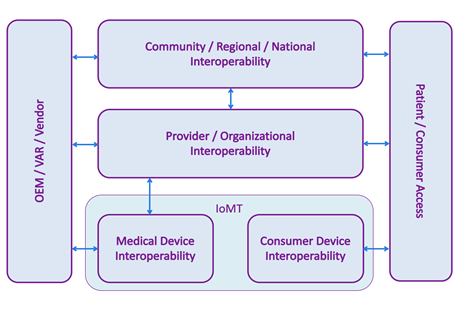 Interoperability today spans more systems and settings than ever before, and “interoperability” means different things to different audiences, so it’s worth taking a moment to ponder the modern interoperability landscape. The following model is an expansion of one suggested by the National Academy of Medicine
 The majority of seniors over the age of 65 (