The Office of the National Coordinator for Health Information Technology (ONC) announces that The Sequoia Project has been awarded a cooperative agreement to serve as the Recognized Coordinating Entity (RCE). The RCE will be responsible for developing, updating, implementing, and maintaining the Common Agreement component of the Trusted Exchange Framework and Common Agreement (TEFCA). The Common Agreement will create the baseline technical and legal requirements for health information networks to share electronic health information and is part of ONC’s implementation of the 21st Century Cures Act (Cures Act).
“The Sequoia Project was selected through a competitive process to help with the interoperable flow of health information. We look forward to working in close collaboration with The Sequoia Project and across the broader health system to create a Common Agreement that best serves the needs of all stakeholders,” said Don Rucker, MD, National Coordinator for Health Information Technology.
In the Cures Act, Congress directed HHS to advance trusted exchange of electronic health information among health information networks through the Trusted Exchange Framework and Common Agreement. The Cures Act’s focus on trusted exchange is an important step toward fostering transparency and competition throughout the healthcare delivery system by addressing the technical barriers and business practices that impede the secure and appropriate sharing of electronic health information.
In addition to the Common Agreement, the RCE will collaborate with ONC to designate and monitor Qualified Health Information Networks (QHIN), modify and update accompanying QHIN technical requirements, engage with stakeholders through virtual public listening sessions, adjudicate noncompliance with the Common Agreement, and propose sustainability strategies to support TEFCA beyond the cooperative agreement’s period of performance.
“We have learned through our own operations that seamless nationwide sharing of health information is most readily enabled through trust agreements, consistent policy and technical requirements, and appropriate, balanced governance to provide assurance of trust and interoperability. We look forward to working alongside ONC as the Recognized Coordinating Entity,” said Mariann Yeager, CEO of The Sequoia Project.
As provider adoption of electronic health records (EHRs) approaches near-universal levels, a study from The Doctors Company shows the frequency of claims in which EHRs contributed to injury continues to rise.
Analyzing EHR-related medical malpractice claims that closed between 2010 and 2018, The Doctors Company uncovered that the pace of these claims tripled, growing from a mere seven cases in 2010 to an average of 22.5 cases per year in 2017 and 2018.
While EHRs are not often the primary cause of claims, the study shines a light on potential risks they may pose in care delivery, as well as the top factors that contributed to the claims. The study showed that EHR-related claims were caused by either system technology and design issues or by user-related issues. Among the top findings:
Top user-related issues stem from incorrect information, pre-populating or copying and pasting, and hybrid health records or EHR conversion.
Top system technology and design issues were problems with electronic systems and technology failure.
Of those injuries that occurred in 7 percent or more of claims, adverse reaction to a medication and death were by far the most prevalent.
Diagnosis-related allegations represented nearly one-third of the total.
Two specialties—family medicine and internal medicine—received the highest percentage of claims where EHRs are a factor, followed by cardiology and radiology.
Based on this data, study author Darrell Ranum, JD, CPHRM, vice president of patient safety and risk management at The Doctors Company, identified the following steps to prevent EHR-related risks that may ultimately contribute to an adverse event:
NTT DATA Services announces a collaboration with Google Cloud to develop next-gen healthcare solutions designed to improve patient experience, while creating more efficient operations and reducing costs for providers and health plans.
NTT DATA is working with Google Cloud to deliver digital offerings in cloud, analytics and artificial intelligence that enable providers to gain better access to insights and solutions needed to foster better patient outcomes. These solutions will also help health plans better engage with members and providers in an environment of rapidly changing payment models, regulations and technology.
Alan Hughes
“There is a significant need for patients, providers and health plan administrators to have better access to clinical data and decision support. By collaborating with Google, we’ll work to solve industry issues with innovative solutions that provide new insights, create a healthcare experience similar to the retail models that consumers expect, improve the quality of care while reducing cost, and drive better outcomes for healthcare organizations,” said Alan Hughes, president, Global Healthcare & Life Sciences, NTT DATA Services. “Google Cloud is a leader in analytics and artificial intelligence. Combined with our global capabilities, investments in healthcare and industry expertise, there is a tremendous opportunity to dramatically improve the current ecosystem for all parties.”
NTT DATA healthcare solutions support nearly 80 million doctors, patients and employees in the U.S. alone. The company was recently ranked the second largest and most experienced global IT services provider in healthcare by HfS Research, including the No. 1 ranking for providers and the greatest geographical coverage. This substantial footprint in patient care will enable NTT DATA and Google Cloud to develop and deliver next-generation solutions that incorporate digital technologies, such as AI, machine learning and IoT. NTT DATA plans to share more on these solutions later this year.
EHR general dissatisfaction is well-known. Despite how hard electroni? patient records can be to use, a number of doctors are saying the technology has made them better caregivers.
Our friends at Belitsoft (a medical software development company) have brought you answers to some important questions. Why do physicians prefer using EHRs and how this technology improve their workflow? What EHR features make doctors keep up to date? Read on to find out!
Quick access to comprehensive medical records
EHR is advocated as a doorway to smarter and more accessible healthcare. The Surescript report found that one-third of surveyed can easily determine which other care providers a patient has visited. Specialists are able to compile a comprehensive patient history by using any hit found in their records.
“Having real-time access quickly and reliably to medical information and data 24/7 is important to make this happen. Instead of hunting for lab work in a paper chart or trying to find a specialist’s consultation, I can access the information I need rapidly and focus on the patient in front of me.”
It is usually hard to detect common hospital-acquired infections in a crowded building where patients might get infected at every turn. The research published in JAMA Internal Medicine, “is a brilliant example of how we can learn from data in the electronic health records,” said Robert M. Wachter, MD, professor and chair of the Department of Medicine at UCSF.
The idea belongs to the UCSF Health Informatics team. They realized that each patient’s EHR contains detailed info about every step they had made for every test. Using these digital breadcrumbs found in the records, specialists were able to track patients in time and space, thus discovering a significant source of infection.
Dr. Jen Gunter supports EHR implementation and says she really loves the system. One of the features Jennifer highlights is a full integration with pharmacy services.
She has noted that many patients can’t remember their medications or doses, and even go off the meds she prescribed. Thus, for example, Dr. Gunter can take a guess and potentially have a patient buy an expensive medication.
Alternatively, she can call the pharmacy (if she remembers which services she used) to see if they can track down the right medication history and then she or her nurse appoints a follow-up visit if they get the answer.
However, the only viable option for Dr. Gunter is to use an EHR system. Thus, she can confirm the info with the electronic records and talk with a patient about how and why deviations happened.
Symphion, Inc., a leading software and services company focused on affordably eliminating risk and cost while maximizing operational efficiency in information technology, today announced the official launch of the Symphion’s IoT Cyber Security as a Service solution. This new offering from Symphion is the only service available today to cost-effectively secure IoT devices, independent of make, model or type.
Regulators are recognizing the increasing exposures from Internet of things (IoT) devices and are requiring manufacturers to add features to address security.
“New laws like California’s SB 327, which will take effect in January 2020, require connected devices to be secure,” stated Jim LaRoe, Symphion’s chief executive officer. “We’re just seeing the beginning of these types of regulations requiring that security features must be added by manufacturers to protect devices and the networks that they are connecting to. At Symphion, we recognized this need for printers, the most prevalent and mature Internet of Things devices, and designed our Print Fleet Cyber Security as a Service solution using artificial intelligence to identify and maintain preventative cyber hardening using the built-in security features. To address the broader IoT market development and the anticipated introduction of security features, we’re introducing our newest service, IoT Cyber Security as a Service.”
Currently, networked printers form the largest number of IoT devices across most enterprises in the US today – with the estimated number being above 100 million deployed on networks. Of those, it is estimated that less than two percent are properly configured for security, creating the greatest threat to network security today. Industries like healthcare, energy, finance and government are at significant risk due to increased regulations that have expanded fines for not properly securing IoT devices, including networked printers.
“We knew that cyber hardening all our printers (IoT devices), bringing them into change control and compliance reporting were what we had to do,” stated Jason Johnson, Marin General Hospital’s information security officer and president of the HIMSS Northern California Chapter. “Even with our print fleet of fewer than 1,000 printers and around 60 models, for us to try to manually do what Symphion does would easily have run us in excess of $400,000 per year for only a fraction of what they provide and would have been wholly ineffective.”
Symphion’s IoT Cyber Security as a Service™ is a turnkey security configuration management service for IoT devices – completely and remotely delivered by Symphion. This affordable service manages the available security setting (regardless of make or model), monitors those settings and automatically remediates them their planned, controlled state.
For more information on where to purchase and service details, visit https://symphion.com
Appriss Health, provider of the most comprehensive platform for opioid stewardship and substance use disorder (SUD) in the U.S., today announced that the South Dakota Board of Pharmacy is now using its PMP Gateway integration service to provide NarxCare and state prescription drug monitoring program (PDMP) information to all prescribers and pharmacists directly within electronic health record (EHR) and pharmacy management systems.
PMP Gateway is the Appriss Health managed service platform enabling the integration of its NarxCare platform and PDMP information within real-time care team workflow to help providers make more informed clinical decisions at the point of care.
NarxCare utilizes, analyzes and presents information from South Dakota’s PDMP and enables the availability of additional data sources to empower clinicians to identify patients who may be at risk for SUD, overdose and death. NarxCare provides machine learning and artificial intelligence-based patient risk scores and clinical alerts in a visually interactive format to aid prescribers and pharmacists with clinical decision support. NarxCare also helps clinicians connect patients with additional resources within their community if needed, such as medication-assisted treatment.
By delivering NarxCare and PDMP information within workflow through PMP Gateway, this one-click process eliminates the need for prescribers and pharmacists to manually log into the state PDMP separately and then enter a patient’s name and demographics to search for them. Healthcare providers and pharmacists can better evaluate and quickly intervene on behalf of patients with instant access to real-time information and insights.
Kari Shanard-Koenders, RPh.
“Partnering with Appriss Health increases our prescription drug monitoring program’s overall effectiveness and helps to better address the evolving opioid epidemic head on,” said Kari Shanard-Koenders, RPh., executive director of the South Dakota Board of Pharmacy. “Through PMP Gateway and NarxCare we are providing South Dakota’s prescribers and pharmacists with easier access to PDMP information and other important insights right within their clinical workflow, which enhances clinical decision support, patient support, patient engagement and care coordination.”
More than 100 C-Suite and director level executives voted and then ranked the top 10 critical challenges, issues and opportunities they expect to face in the coming year, during this week’s HCEG Annual Forum. The HealthCare Executive Group (HCEG), a 31-year old networking and leadership organization, facilitated interactive discussions around such issues in their 2.5 day marquee event in Boston.
Executives from payer, provider and technology partner organizations were presented with a list of over 25 topics. Initially compiled from webinars, roundtables and the 2019 Industry Pulse Survey, the list was augmented by in-depth discussions during the Forum, where industry experts explored and expounded on a broad range of current priorities within their organizations. The HCEG Annual Forum concluded with HCEG Board Members announcing the results of the year-long process that determined the 2020 HCEG Top 10.
2020 HCEG Top 10 Challenges, Issues and Opportunities
Costs & Transparency — Implementing strategies and tactics to address growth of medical and pharmaceutical costs and impacts to access and quality of care.
Consumer Experience — Understanding, addressing and assuring that all consumer interactions and outcomes are easy, convenient, timely, streamlined, and cohesive so that health fits naturally into the “life flow” of every individual’s, family’s and community’s daily activities.
Delivery System Transformation — Operationalizing and scaling coordination and delivery system transformation of medical and non-medical services via partnerships and collaborations between healthcare and community-based organizations to overcome barriers including social determinants of health to effect better outcomes.
Data & Analytics — Leveraging advanced analytics and new sources of disparate, non-standard, unstructured, highly variable data (history, labs, Rx, sensors, mHealth, IoT, Socioeconomic, geographic, genomic, demographic, lifestyle behaviors) to improve health outcomes, reduce administrative burdens and support transition from volume to value and facilitate individual/provider/payer effectiveness.
Interoperability/Consumer Data Access — Integrating and improving the exchange of member, payer, patient, provider data and workflows to bring value of aggregated data and systems (EHR’s, HIE’s, financial, admin and clinical data, etc) on a near real-time and cost-effective basis to all stakeholders equitably.
Holistic Individual Health — Identifying, addressing and improving the member/patient’s overall medical, lifestyle/behavioral, socioeconomic, cultural, financial, educational, geographic and environmental well-being for a frictionless and connected healthcare experience.
Next Generation Payment Models — Developing and integrating technical and operational infrastructure and programs for a more collaborative and equitable approach to manage costs, sharing risk and enhanced quality outcomes in the transition from volume to value. (bundled payment, episodes of care, shared savings, risk-sharing, etc).
Accessible Points of Care — Telehealth, mHealth, wearables, digital devices, retail clinics, home-based care, micro-hospitals; and acceptance of these and other initiatives moving care closer to home and office.
Healthcare Policy — Dealing with repeal/replace/modification of current healthcare policy, regulations, political uncertainty/antagonism and lack of a disciplined regulatory process. Medicare-for-All, single payer, Medicare/Medicaid buy-in, block grants, surprise billing, provider directories, association health plans, and short-term policies, FHIR standards, and other mandates.
Privacy/Security — Staying ahead of cybersecurity threats on the privacy of consumer and other healthcare information to enhance consumer trust in sharing data. Staying current with changing landscape of federal and state privacy laws.
By Ken Perez, vice president of healthcare policy, Omnicell, Inc.
Ken Perez
Transparency has been a popular concept for many years. While some would call it a buzzword, the Trump administration has made it a repeated theme of several of its pronouncements regarding healthcare reform.
Executive Order (EO) 13813, “Promoting Healthcare Choice and Competition Across the United States,” issued by President Donald Trump on Oct. 12, 2017, promoted transparency by aiming to “improve access to and the quality of information that Americans need to make informed healthcare decisions, including data about healthcare prices and outcomes.”
Five months later, at HIMSS18, Centers for Medicare and Medicaid Services (CMS) Administrator Seema Verma promised “to put patients at the center of the healthcare delivery system and empower them with the data they need to make the best decisions for themselves and their families.”
And on June 24, President Trump issued an almost 1,600-word EO, “Executive Order on Improving Price and Quality Transparency in American Healthcare to Put Patients First,” that has as its purpose “… to enhance the ability of patients to choose the healthcare that is best for them” by providing them with access to useful price and quality information, which enables them to find and choose low-cost, high-quality care. Patients will be able to compare prices across hospitals. Posting of standard charge information will apply to all services, supplies, or fees billed by the hospital, and hospitals will be required to regularly update the posted information.
Moreover, this EO mandates that the Departments of Health and Human Services, Treasury and Labor produce a proposal to require healthcare providers, health insurance issuers, and self-insured group health plans to provide or facilitate access to information about expected out-of-pocket costs for items.
The Trump administration is thus taking a consumer-driven approach to try to reduce healthcare costs. As former Rep. Ernest Istook (R-Okla.), president of Americans for Less Regulation, said, “Everything is based upon the theory that consumers would wade through the data to decide whether to seek care from different hospitals or doctors and would pay less.”
But would they? Gallup surveys have shown that Americans are increasingly feeling overwhelmed with the abundance of information. Consequently, consumers take shortcuts to ease the burden. For years, newspapers have lamented that nobody reads their stories, with most readers simply looking at the headlines and skimming a few articles. CNBC reports that about half of the visitors to its website quit after reading the first three paragraphs of a story.
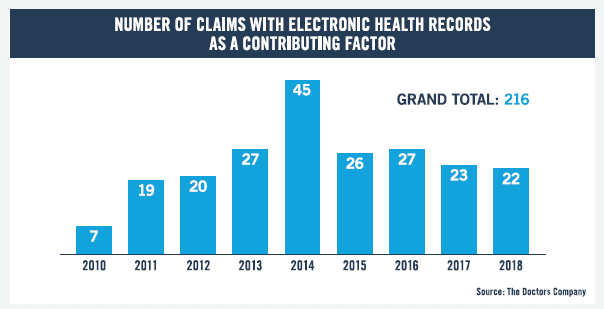 Analyzing EHR-related medical malpractice claims that closed between 2010 and 2018, The Doctors Company uncovered that the pace of these claims tripled, growing from a mere seven cases in 2010 to an average of 22.5 cases per year in 2017 and 2018.
 Appriss Health