Bring-your-own-device or BYOD policies are becoming not just an option, but in many cases necessary because of remote and work-from-home scenarios. BYOD is an increasing priority for IT admins to give employees secure access to the resources they need to do their jobs.
The use of zero-trust architecture is one way to create network security even with a BYOD policy, but there are other things to keep in mind as well. The following are things to know about BYOD policies in general and the cybersecurity implications.
BYOD policies
Under a BYOD IT policy, employees aren’t just permitted but are sometimes encouraged to bring their own devices to access systems and data. Devices can include laptops, smartphones, and tablets.
There are some general options as far as provisioning of access levels when employees use their own devices.
You can offer unlimited access for their personal devices. You can instead allow only access to non-sensitive data and systems on their devices. Another option is to provide access, but with IT control over devices and the fourth option is access, but with the prevention of local data storage on these devices.
There are significant benefits to a BYOD policy for many employers because it can promote productivity and managed risk. Many employees also prefer it. Employees can choose what devices they’re most comfortable using. Due to that comfort, employees are more likely to be productive because they already know how to use them. This might help with buy-in on new technology too.
BYOD policies can cut the costs for your business and alleviate pressure on the IT budget. While there are upsides, there are some potential risks.
From ordering pizza to managing your finances, new technology is changing the way we live our everyday life. And now, more than ever before, these innovations are finding ways to impact the healthcare industry in incredible ways!
Technology has become an integral part of the healthcare industry as it is filled in every corner of every hospital and has a significant impact on both healthcare workers & patients alike. These tech facilities have greatly assisted healthcare workers, transforming their works into more efficient processes with greater accuracy than ever before!
Nurses are the backbone of every healthcare team. Being a nurse is highly demanding & this hasn’t been highlighted better than during the COVID-19 pandemic. As nursing profession requires the core of what makes us human- it can never be replaced by technology.
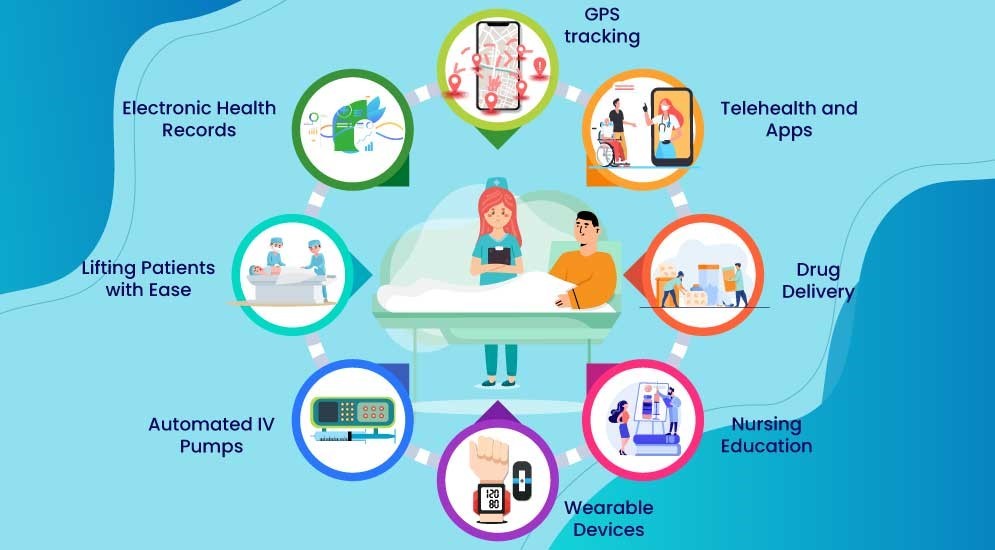
Technology and the nursing profession are not replacements for one another; instead, they complement each other. In fact, the WHO’s State of the World’s Nursing Report 2020 emphasized the significance of technology in both nursing education and practice.
Let’s have a glance at the most promising ones.
Electronic Health Records (EHR)
EHRs are replacing traditional paper filing processes. Electronic health records are an excellent way for nursing experts to document care provided and retrieve information that can help prioritize patient needs. Moreover, data entered into computer systems can be accessed by the care team, which includes doctors & even patients when necessary.
While privacy and security continue to be a concern for Electronic Health Records, HIPAA laws ensure that the organizations preserve the confidentiality of electronic records. New technology like blockchain and cryptography are easing these concerns with its anonymity features, allowing easier access to various aspects of your medical history without compromising personal information or data breaches.
The electronic health records inform the registered nurses about the subsequent steps they need to take for a patient, supervising minor condition changes & providing them information instantly as reminders or alerts. Real-time health condition updates impact the accuracy and speed of medical care.
Catering to unceasing challenging situations and maintaining sanity control over senses are a few of the intrinsic characteristics of a daunting nursing occupation. Similarly, the nursing staff cannot utterly overlook the attendants of the patients and strictly deny their participation in attaining inclusive patient care. Thus, nurses are required to adeptly handle issues related to patients’ family members as well.
Apart from providing tailored service, nurses can play an active role in empowering patients and their attendants towards an extended rehabilitation process. For instance, nurses need to identify and disentangle barriers to a patient’s treatment. In addition, nurses should cultivate a conducive environment for the sake of patients. Similarly, engaging close associates to satisfy certain patients’ personalized needs can help achieve healthcare objectives holistically.
Hence, nurses’ contribution is vital to ensure patients’ well-being does not get compromised due to a tug of the war-like situation among different players. The following sections further explore what strategies nursing professionals should adopt to avoid such bottlenecks.
Acquire in-depth knowledge of the prerequisites
While addressing and resolving society’s diverse medical requirements, trainee nurses need to update and expand their awareness. Likewise, to execute medical procedures more efficiently, it is equally essential for learner nurses to adapt to socio-cultural and familial norms.
Hence, to efficiently understand and deliver as per healthcare-related requirements of the society, beginner-level nursing individuals should pursue advanced academic programs. Apart from that, advanced terminal degree programs like Doctor of Nursing Practice (DNP) can empower practicing nurses to make an impactful contribution to the overall healthcare sector.
Harris Healthcare’s Data Integrity Solution Business Unit – which includes patient data integrity powerhouses Just Associates, Inc., and QuadraMed Corporation – have entered a strategic partnership with RightPatient to integrate biometric patient identification into its existing suite of master patient index (MPI) management solutions.
Doing so provides important protections against front-end contamination of the MPI and EMPI and helps eliminate the patient misidentification and safety issues created by “dirty” patient identification data. This is especially important now as spikes in remote patient registrations due to COVID-19 have led to a sharp increase in duplicate patient records.
“Biometric protections from RightPatient perfectly complement our existing suite of patient data integrity solutions by guarding against creation of new duplicate and overlaid patient records at the point of registration, while we focus on creating and maintaining a pristine MPI/EMPI environment and supporting rapid and accurate patient identification,” said Lora Hefton, executive vice president of the Harris Data Integrity Solution (DIS) Business Unit. “This partnership advances our ability to address key health information issues by reducing the volume of potential duplicate medical records while securing patient information and minimizing the ongoing cost of maintaining quality patient data.”
Mohu Sultana, CEO of RightPatient adds: “We live in a very uncertain time. Increased cybersecurity threats put hospitals at risk of losing millions of dollars due to medical identity theft. The long-term impact of COVID-19 is also a critical factor in properly treating patients as we move forward – hospitals must know who is who to ensure proper treatment plans. Reliable patient identification is more important than ever. Our partnership with Harris demonstrates the commitment of both organizations to protecting the entire community against financial loss while ensuring patient safety.”
RightPatient provides the healthcare industry with the most accurate, scalable, hygienic, and versatile HIPAA-compliant, cloud-based photo biometric patient identification service that also publishes patient photos in health records, wristbands, and other applications to improve patient safety.
With easy implementation and seamless integration into any electronic health record (EHR) system – including the SmartID Platform from QuadraMed – RightPatient solutions reduce denied claims, lower medical errors because of misidentification, and prevent duplicate medical records. They also ensure accurate patient identification at any point along the care continuum while protecting medical records against unauthorized access, ransomware attacks and other data breaches.
From data analysis to cleanups, Just Associates performs the critical tasks necessary for hospitals and health systems to achieve and maintain a highly accurate and quality MPI. Its state-of-the-art suite of identity management solutions and services includes continuous duplicate detection with IDSentry – which features HIM workflow and dashboard tools and identifies more true duplicates than systems relying on basic and intermediate patient matching algorithms – as well as IDManage for ongoing MPI management and IDResolve for customized MPI clean-up services.
QuadraMed brings together the expertise, systems knowledge and technology that enable delivery of tailored, value-added solutions that improve healthcare organizations’ financial outcomes and business processes while supporting delivery of quality patient care. Its flagship SmartID Platform is a HIPAA-compliant EMPI management platform that diagnoses, treats, and cures errors, delivering real-time duplicate and overlay detection and robust enterprise-wide patient search based on a probabilistic algorithm with up to 99% accuracy in matching patient records.
To learn more about integration of RightPatient into the MPI/EMPI patient matching and data integrity management solutions from Harris DIS, visit Just Associates’ virtual booth during the AHIMA21 Virtual Conference, taking place through Sept. 22, 2021.
Managed Markets Insight & Technology (MMIT) and Evaluate (a Welsh, Carson, Anderson & Stowe and Hg portfolio company)—which joined forces last month to become a $1.6 billion global pharma commercial intelligence provider—announced the acquisition of Panalgo, a premier healthcare data analytics company that serves many of the largest biopharmaceutical, medical device and contract research organizations around the globe.
“MMIT/Evaluate and Panalgo share a vision of generating evidence and insights faster, all to help patients get timely access to lifesaving therapies,” said MMIT CEO Mike Gallup. The addition of Panalgo fits perfectly into our strategy of building a best-in-breed technology and services-driven healthcare business servicing pharma, biotech and beyond.”
With this acquisition, MMIT/Evaluate aim to transform the process of bringing drugs to market. By incorporating Panalgo’s flagship Instant Health Data (IHD) software, MMIT/Evaluate will offer customers an end-to-end commercialization platform that provides critical, data-driven insights instantly, allowing life sciences leaders to make better decisions faster.
“The ability to quickly generate insights, inform decisions on the effectiveness and safety of new treatments, and reduce barriers to accessing care, all fulfill a huge need in the marketplace,” said Panalgo CEO Joseph Menzin, Ph.D. “With Panalgo’s best-in-class platform, MMIT’s expansive base of over 1,300 biopharma and payer customers, and its gold-standard formulary data, we are well-equipped to support clients from end to end.”
On Nov. 1, 2021, Jordan Menzin, CTO, will become CEO of Panalgo, and Joseph Menzin will transition to the role of Executive Chairman. Panalgo will continue operating under its brand to provide the same innovative IHD software and high-quality customer support.
“I’m excited to lead this next phase of Panalgo’s growth,” said Jordan Menzin. “Together, we’ll help clients solve problems by leveraging quicker, more efficient insights—and, ultimately, get therapies into the hands of the patients who need them.”
Greenway Health, a leading health information technology services provider, today announced enhanced offerings with Greenway Revenue Services (GRS), which provides revenue cycle management support to clients. Due to clients placing a stronger emphasis on the revenue cycle in response to the COVID-19 pandemic, the company announced GRS Select earlier this year, which delivers more flexible support options for swift and targeted relief to healthcare practices. Greenway will continue to expand GRS services over the next 12 months to further assist clients with their financial relief strategies. The company will also further leverage AI automation and build additional GRS analytics that improve productivity and efficiency within the revenue cycle.
According to a recent MGMA study, 44% of healthcare leaders reported their 2021 visit volumes are below their pre-pandemic levels and ambulatory practices are still facing negative financial impacts due to the pandemic. Greenway developed its GRS offerings based on such emerging needs of its clients, to further help ambulatory care practices improve their financial health. The company is already seeing significant interest, with longstanding EHR clients such as Tier 1 Institute Orthopedic and Neurosurgical adding GRS.
To lead this expansion, Greenway has appointed its Chief Compliance Officer, Susan Kohler, to a new role as senior vice president of Revenue Services. A tenured employee with more than 15 years of experience leading healthcare operations in revenue cycle, claims, payer and provider network management, and electronic data interchange (EDI), Kohler will now oversee operations for both GRS and Greenway Clearinghouse Services.
The U.S. Department of Health and Human Services’ (HHS) Office of the National Coordinator for Health Information Technology (ONC) today awarded $73 million in cooperative agreements as part of its Public Health Informatics & Technology Workforce Development Program (PHIT Workforce Program). Announced earlier this year and funded through the American Rescue Plan, the program aims to strengthen U.S. public health information technology (IT) efforts, improve COVID-19 data collection, and increase representation of underrepresented communities within the public health IT workforce. ONC will support the overall administration of the program.
“While we work to tackle the pandemic, we won’t take our foot off the gas when it comes to preparing for any future public health challenges,” said Health and Human Services Secretary Xavier Becerra. “Thanks to the American Rescue Plan, we can invest in growing our nation’s public health workforce today to better meet the needs of tomorrow. And as we work to expand talent, whether it’s in the field of technology or public health informatics, we will do so with an eye towards promoting diversity.”
The 10 awardees, comprising Historically Black Colleges and Universities (HBCUs), Hispanic Serving Institutions (HSIs), Asian American and Native American Pacific Islander-Serving Institutions (AANAPISIs), other minority-serving institutions (MSIs), and other institutions of higher education, will form multiple consortia to collectively train more than 4,000 individuals over a four-year period through an interdisciplinary approach in public health informatics and technology.
Healthcare consumers (aka “your patients”) have easily purchased goods and services on the Web for years and now expect that level of ease with their healthcare experience. So, what’s the problem? Unfortunately, the healthcare industry lags at least a decade behind e-commerce giants like Amazon and travel industry leaders like Expedia that set the standard for intuitive, consumer-friendly online engagement.
Now, more than ever, patients are demanding the same conveniences from their healthcare, but the specialized tools needed to deliver an excellent patient financial experience are missing from many EHRs.
The simple truth is EHRs were developed to help physicians and other clinicians manage clinical data, not promote and encourage consumerism. Currently, most EHRs are not optimized to provide the administrative, financial or customer engagement solutions needed to transform time-consuming and manual administrative and financial interaction into safe, efficient, digital information exchange. Hospitals and health systems can add a complementary system to their EHR that can easily improve the non-clinical patient experience. Incorporating digital patient engagement into EHRs is a smart investment because it can help providers address the following operational pain points:
Patient Demand: Patients want more control over their healthcare experience, yet there is a chasm between patient expectations and what healthcare organizations provide. More than 90% of patients said they would leave providers offering an inferior digital experience.
Patient and Staff Safety: The pandemic led patients and staff to demand safer visits and access to virtual tools that reduce contact. It’s a catalyst for consolidating disparate vendors and upgrading functionality by utilizing a single, integrated platform for patient alerts, pre-registration, eligibility verification and price estimation.
Efficiency: Embracing digital patient engagement technology means transferring many tasks registrars perform to patients, freeing those employees to perform higher-touch patient-centered activities.
Government Policy: Forward-thinking hospitals embrace price transparency regulations not only for regulatory compliance but also to provide meaningful price insights patients want and deserve — a better patient financial experience.
Pricing Pressure and Volume Shifts: Patients who obtain accurate price estimates will seek care where perceived quality is equal or better and provided at a lower cost. If you’re delivering value and can demonstrate it, you’ll attract and retain patients.

 Catering to unceasing challenging situations and maintaining sanity control over senses are a few of the intrinsic characteristics of a daunting nursing occupation. Similarly, the nursing staff cannot utterly overlook the attendants of the patients and strictly deny their participation in attaining inclusive patient care. Thus, nurses are required to adeptly handle issues related to patients’ family members as well.