As part of Validic‘s efforts to address the global coronavirus (COVID-19) outbreak, the company launched a real-time monitoring solution designed to observe, analyze and triage individuals remotely for the emergence of COVID-19 symptoms.
COVID-19 Home Monitoring tracks a person’s body temperature, difficulty breathing, cough frequency and oxygen saturation. The solution provides real-time analysis and escalation of critical health data to care management teams, public health officials and/or human resource administrators.
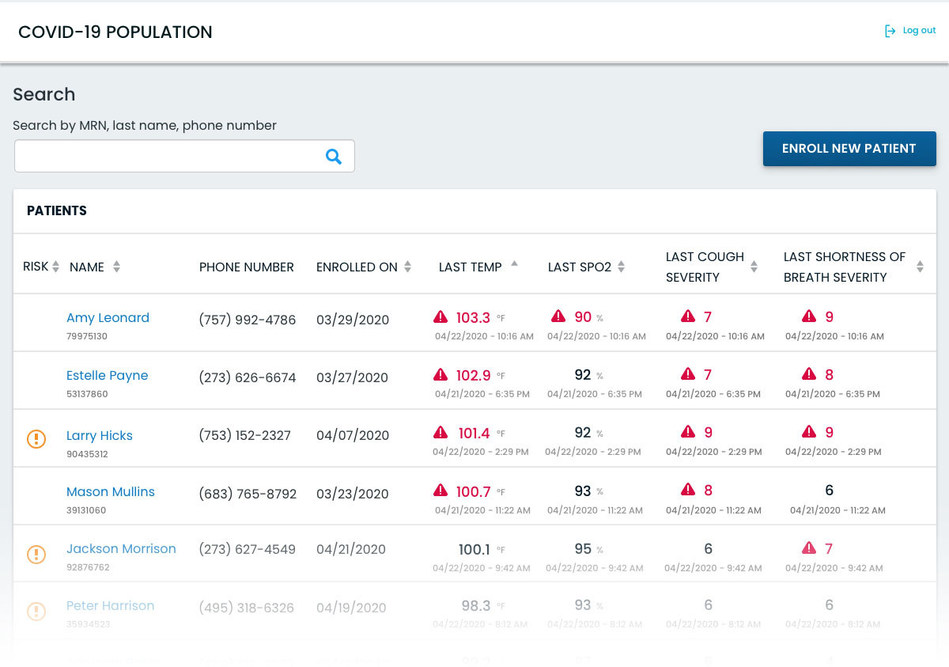
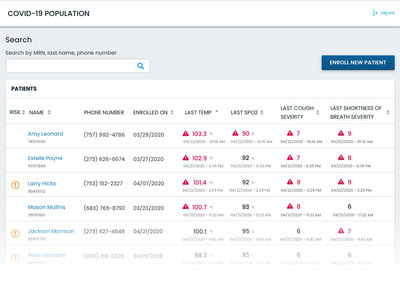
Dashboard panel view to triage patients and view individuals’ real-time and trending home health data. The dashboard allows clinicians or administrators to enroll new individuals; set alerts and triggers; identify trends quickly; and, search individuals based on status and latest readings.
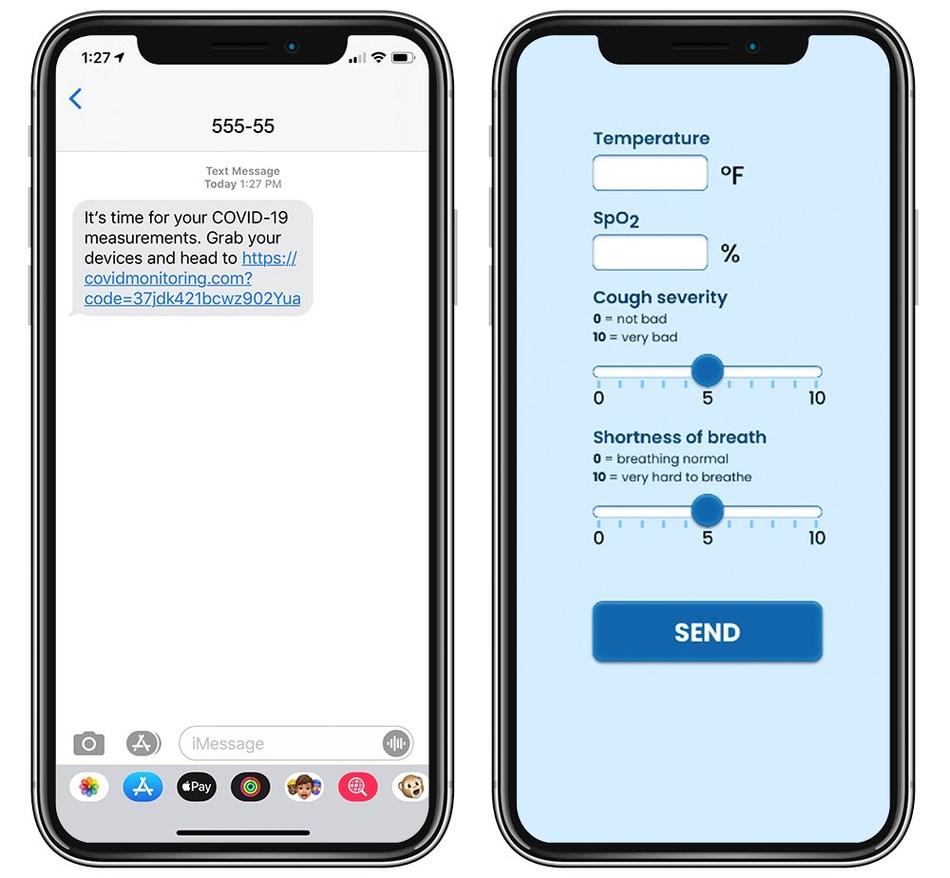
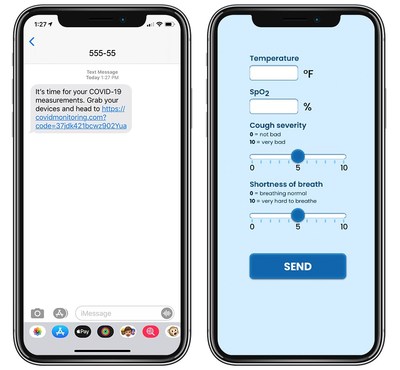
Patients submit health data via secure text or email message. Individuals share daily –& or more regular – updates on symptoms: body temperature, difficulty breathing, cough frequency, and oxygen saturation.
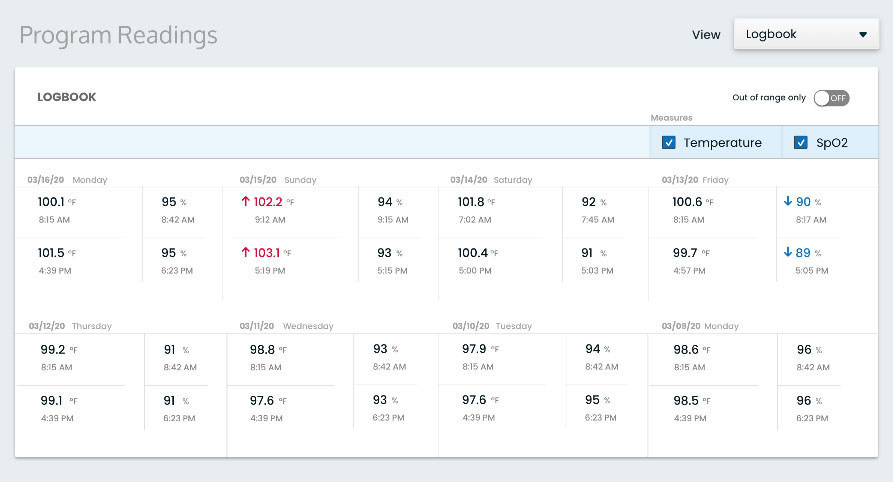
Patient logbook view of current and historical biometric readings and symptoms.
In an effort to empower people on the frontlines of this health crisis, the solution is designed for rapid deployment and scale:
Triage individuals, monitor health metrics and codify next steps
Bulk enroll thousands of individuals quickly
Automate measurement reminders via text and/or email
Triggered alerts will notify program administrators or clinicians as a person’s symptoms worsen, improve, or remain static – or as a quarantine period ends with no symptoms present.
“Given our expertise in personal health data and remote patient monitoring, we’ve been working to quickly develop and launch a custom COVID-19 solution that allows for proactive, remote interventions using real-time data. At no time in recent history has there been a higher imperative to use distance monitoring to keep people alive and healthy,” Drew Schiller, CEO of Validic, said.
“Everyone’s safety, especially those individuals who cannot self-isolate – like our emergency responders, nurses, and sanitation workers – need to be a foremost priority, especially at this time. We want all healthcare professionals and employers to be able to leverage industry-leading remote monitoring capabilities to help people impacted by or potentially exposed to coronavirus.”
As health systems, health plans and employers across the country continue to face an urgent need to monitor people for the emerging symptoms of COVID-19, Validic is offering this solution with a flexible, month-to-month plan that ensures organizations can access the platform without financial constraints.
Companies in the healthcare field have a lot of unique challenges compared to those in other industries. For example, while healthcare companies still, of course, have the same universal business challenge of attaining – and maintaining – profitability, they also have specific healthcare-related challenges such as:
maintaining positive patient outcomes
following safety and privacy regulations
keeping up with advancements in healthcare technology
retaining and attracting talent despite a major healthcare talent crisis: too many experienced workers are retiring / leaving healthcare and there’s not enough incoming talent to fill the void. As a result, the healthcare industry will add about 2.3 million new jobs from 2016 to 2026, which is three times more than other industries (S. Bureau of Labor Statistics)
While each of the above challenges is important, the healthcare talent crisis has the potential to wreak the most damage to healthcare companies, since every organization needs talent to do…well, anything. And more specifically, it’s not uncommon to find leaders in the healthcare industry feeling stuck when it comes to recruiting talent and leveraging employer branding to help them do so.
Here’s how to approach employer branding in healthcare:
Consolidate brand mindshare in your current employees
Sometimes it costs more to recruit, hire and train new employees than it does to maintain your existing work force. This is one reason why you will want to place a priority on consolidating mindshare amongst current workers so that when you do need to recruit new employees, you’ll be able to take on that task more easily and in a more focused way. In other words: if you get your current employees unified and supportive of your company’s employer brand from the inside out, showcasing your company to potential candidates gets to be MUCH simpler.
Do this by displaying your company’s branding within the organization’s walls (on signage as well as printed materials from stationary to logos on coffee mugs) as well as in all electronic documents to clearly establish and reinforce your identity among existing talent. Also, you should find ways to communicate and celebrate your organization’s purpose — your reason for existing! — by sharing your mission statement and code of values any chance you get.
Monitor and manage your reputation as an employer
Your healthcare employer brand ought to help you attract better candidates who want to be associated with a top company. So, employer branding includes flaunting all of the benefits you offer to your employees, staying on top of any press and news that your company gets so that there’s no PR damage, and actively responding to your online company reviews from current and former employees to show that you’re a thoughtful employer with a good reputation. You can count on attracting much more interest from top-quality candidates when your employer brand reputation is nothing short of stellar.
Use of telemedicine in the U.S. has been low to date. However, asexpected, it is expected that demand for these services will increase dramatically over the next few months because of the coronavirus (COVID-19) crisis, says GlobalData, a leading data and analytics company.
Telemedicine has been touted as a critical strategy during the COVID-19 emergency to limit the risk of person-to-person transmission of the virus, prevent emergency rooms from being inundated, reduce barriers to screening, and allowing those with moderate symptoms to be treated from home. Teladoc Health, a telehealth provider, announced that patient visit volume had increased by 50% since the previous week and was continuing to rise.
Kathryn Whitney, MSc, director of thematic analysis at GlobalData, said: “Prior to the COVID-19 crisis, telemedicine had never reached its full potential in the US, with several barriers preventing its widespread uptake. These include lack of reimbursement and restrictions affecting access for rural populations, general lack of awareness of these services, and the desire of the sick to see their physician in person.”
Since early March, regulations in the US governing the use of telemedicine have changed regularly, which will expand access to services during the COVID-19 emergency, particularly for Medicare beneficiaries who are deemed at high risk for the virus. In certain states, including California and New York, officials have also announced that payers must offer telehealth services as part of their emergency plans. In Massachusetts, payers must cover the COVID-19 testing and treatment via telehealth, and cannot impose cost sharing via co-pays, deductibles, or coinsurance, and prior authorization is not required to receive treatment via telehealth.
Whitney continues: “Recent changes to regulations by the U.S. government will remove many of the financial barriers to telehealth and drive the use of these services, particularly among older and vulnerable populations. People will also become more aware of these types of services, given amount of information being disseminated by the government, hospitals, healthcare systems and payers.
“As more U.S. cities and states begin to lock down and social distancing becomes the new normal for the foreseeable future, Americans are likely to change their views on telemedicine. With the ongoing risk of virus transmission, people will be eager to avoid hospitals and get screened and receive care from the safety of their own homes.”
By Kristin Weir, vice president of product, MedeAnalytics.
Kristin Weir
When it comes down to the most basic purpose of why organizations use analytics, it’s simple: they want to uncover insights that help them take the next best step or make the best decision. These healthcare organizations often need, however, all the components of the enterprise analytics story to be able to do that.
Unfortunately, few organizations today have that capability because of the fragmented nature of the healthcare analytics industry. There are hundreds of vendors claiming to do healthcare analytics in the market. Many of those vendors offer wonderful point solutions, whether it be for population health, revenue cycle management, cost and operations, or employer reporting. But this partitioning of analytics has led to organizations purchasing upwards of 20 or more different solutions.
Each niche solution is like a chapter in the entire book of the enterprise analytics story that the organization is telling. The problem in that scenario is that each chapter is from 20 different books and they don’t tell a comprehensive story. In analytics terms, those chapters are not interoperable.
Organizations with multiple niche solutions are faced with trying to stitch together chapters from different books to create their stories. One book is a mystery, the next a romance, the next is sci-fi and so forth. By the time a single story is created, the narrative is confusing, incomplete and utterly incomprehensible by end-users.
Reading chapters from the same book, however, helps healthcare tell a comprehensive, single, trustworthy story. They can weave together insights from different chapters to arrive at the conclusion.
What does having one book mean from an enterprise analytics perspective? With enterprise analytics, you are extending analytics across the healthcare ecosystem. You’ll be able to accelerate goals and solve business challenges, improve outcomes for providers, strengthen cost and quality for health plans, and create a single source of truth on one platform with interoperable solutions.
Why do healthcare organizations use so many different vendors? There are a variety of reasons, but these are the top two:
They may have purchased at the department level versus the enterprise level, which often puts the focus of the procurement only on the needs of the department.
As healthcare has evolved, new requirements for enterprise analytics have emerged. Existing vendors may have done a, b, and c well, but now there’s a need for x, y and z; and that is something the original vendor can’t solve for.
In 2020, much in our daily lives can be accomplished virtually. From clothes shopping to ordering groceries, there is a growing desire to accomplish important tasks remotely, allowing individuals to save time and effort on fewer in-person trips.
But with so much technology available, why does healthcare feel like it’s lagged behind?
Traditional telemedicine — typically involving phone calls and occasionally video chats with providers — has helped allow individuals to contact their doctors remotely, which can be a tool for both providers and their patients. The utility of telemedicine, however, has its limits, and it’s crucial for both healthcare professionals and average consumers to understand those limitations and move toward a better method.
That better method is represented by virtual health, a new way of thinking about remote doctor visits that combines the benefits of traditional, in-person doctor visits with the convenience and accessibility of telemedicine by establishing a virtual health hub that can accomplish nearly everything that a traditional visit can. This model involves providers on both sides of the visit, known as a “tele-presenter” model.
As a new decade begins, healthcare needs should be addressed through the innovative technology that drives much of our life. And with the correct shift in emphasis, virtual health can help improve healthcare for people who need it.
Here are three ways virtual health and telemedicine differ, and why the disruptive new platform is worth embracing:
Accurate, Detailed Visits
For the sake of a patient’s wellbeing, receiving an accurate diagnosis from a healthcare professional is critical. But with many telemedicine strategies, a detailed and accurate assessment can be difficult.
With a simple phone call or video chat, a doctor needs to rely on the patient to self-diagnose and can only ask them questions about their symptoms and how they’re feeling. While this can sometimes be effective, a doctor can’t give their best assessment without being in the room with a patient.
Fortunately, virtual health can bridge that gap by allowing a second professional to help the physician assess and diagnose the patient. In the case of the Health In Motion Network’svirtual health hub at Indian Lake High School — a partnership with Mary Rutan Hospital in Bellefontaine, Ohio — a school nurse is on hand with the patient to help relay information to doctors, providing information that typically needs to come from an in-person meeting.
We have all heard of the COVID-19 (Coronavirus) which is believed to have originated in the Wuhan province of China. Which it then started spreading across the globe from major outbreaks in countries like Italy, Spain all the way to the United States. We know now there have been a number of countries who have gone in a nationwide lockdown (Italy, Spain, France, Germany).
Here in the United States, many states have been doing everything they can to limit the spread. For example, most restaurants, bars, and other social gathering areas have been closed or limited. Unfortunately, for healthcare workers, you are on the frontlines of this pandemic. Which will mean you may be the best source of information for family friends and clients.
Here are some tips as to what you may want to do. First, let’s start off with yourself. As we mentioned you are one in the thick of this epidemic and you need to make sure you are being safe and keeping yourself healthy and alert.
Of course, you need to follow the usual protocols of keeping your distance from others (when you can), make sure to be washing your hands when you can and, maybe the hardest for many of those working inside hospitals and clinics, make sure to get a good night’s sleep and eat as healthy as you can to keep up your energy.
Being alert will not only be crucial to keeping yourself safe but it can save a patient or coworker from being exposed to the virus. Whenever a new patient or individual comes to your clinic or emergency room take note of any symptoms they may be experiencing. Some of the known indicators of the COVID-19 (Coronavirus) may include some flu-like symptoms such as cough, fever, sweating, shortness of breath, fatigue and muscle pain.
Advancements in technology make your life easier every day. In the past decade, you’ve seen the smart home become a reality and cell phones are no longer used simply to text and place calls.
Thankfully, technology is also advancing in the medical field and, as such, dramatically helping to improve patient care. Many wearable devices are helping patients not only improve their quality of life but that also allow them and their doctors to monitor medical conditions.
Portable Oxygen
Some devices, such as the oxygen tank, have come a long way in recent years. Instead of having to lug a bulky tank from place to place, many people can now use a smaller design that you simply wear over your shoulder–similar to a purse–or transport in a tote. However, the cost of this device is not covered by all insurance companies. Additionally, many of the people who rely on daily supplemental oxygen are the elderly and they are on Medicare. Using health insurance, such as Medicare for oxygen usage, isn’t always covered 100 percent, making it hard for seniors on social security to live life comfortably.
ECG Monitors
In the past, a person had to visit their doctor periodically to have an EKG performed to monitor their heart health. Today, through advancements in technology, patients can monitor their health from the comfort of their homes. These portable, handheld devices are easy to use and provide almost instantaneous recorded measurements within just a few minutes. This lets patients retain a complete history of their condition over an extended period of time, allowing doctors to review it and use it as a valuable tool to make further recommendations regarding a patient’s health. Additionally, should an alarming reading occur, a patient can contact their doctor and head straight to a hospital.
Blood Pressure
Today patients with a history of high blood pressure can monitor their blood pressure from virtually anywhere. The smartwatch by HeartGuide is worn like a watch on your wrist. It works similarly to the traditional wrap-around blood pressure cuff found in a doctor’s office; only this one expands and then tightens at your wrist. The first of its kind, it has a 100 reading storage capacity and the patient can transfer them to a mobile app called HeartAdvisor. This lets their physician review the readings and proceed with life-saving treatment options.
Carrot Health has developed the COVID-19 Risk Index, which predicts those populations and communities that are most susceptible to the negative impacts from a coronavirus outbreak. The risk index does not predict where and when an outbreak will occur, rather it helps inform public health and intervention decisions at the national, regional and community levels by identifying who is most vulnerable.
Because risk variations across a single metro area can be significant, Carrot Health is also preparing to publish an interactive dashboard that shows the COVID-19 Risk Index and allows users to drill into the data down to the zip code level to identify granular pockets of risk and model different outbreak scenarios. This information can help inform coordination of resources to protect those who are most vulnerable.
Kurt Waltenbaugh
“With the right data, public health personnel can turn panic and passivity into preparation and progress, directing intervention efforts and resources more effectively and appropriately,” said Carrot Health CEO Kurt Waltenbaugh. “It allows for better informed decisions about the types of advance preparations that are necessary and where to divert scarce resources like ventilators and test kits in the event of an outbreak, and identifies populations that require closer monitoring so rapid interventions can be staged with when circumstances warrant.”
Carrot Health Insights | Predicting Coronavirus Risk, which includes multiple charts and graphs breaking down population-based risk, can be accessed online here. It will be updated as more data and scientific studies become available.
Research also suggests that approximately 2% to 4% of people with the virus die, depending on where they live. So far, deaths are higher in males and much higher for those over age 65.
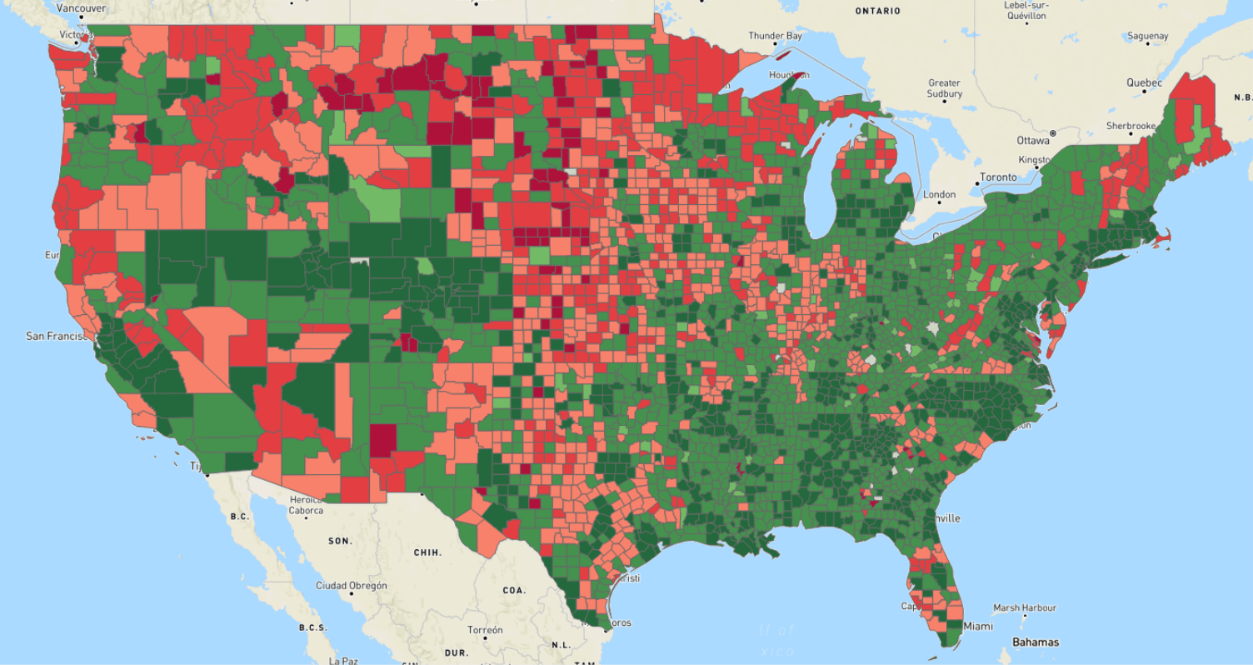
By coupling this information with its extensive database of social determinants of health information and consumer insights, Carrot Health was able to predict COVID-19 vulnerabilities. The following map shows forecasted COVID-19 population risk at the county level (red = high, green = low):
Source: Carrot Health
New data and additional studies might change the assumptions upon which this initial analysis was based. In addition, the actual infection rate may be higher than reported, which would mean that mortality rates could be lower than currently estimated. To that end, the COVID-19 Risk Index will evolve over time.
“These insights are not meant to inspire panic, but to promote thoughtful preparation. Data-driven insights will be critical in saving lives, deploying resources, and minimizing disruption, both for this public health crisis and for future ones. While the U.S. currently remains less affected than some parts of the world, it is nonetheless more vulnerable due to a healthcare system that does not promote prevention or early intervention,” said Waltenbaugh. “Fortunately, we have powerful data tools at our disposal to better prepare and deploy resources, and a culture of helping those who are vulnerable.”
 By Dr. Sarah Müller, managing director,
  Kathryn Whitney, MSc, director of thematic analysis at GlobalData, said: “Prior to the COVID-19 crisis, telemedicine had never reached its full potential in the US, with several barriers preventing its widespread uptake. These include lack of reimbursement and restrictions affecting access for rural populations, general lack of awareness of these services, and the desire of the sick to see their physician in person.”