Primary care physicians are at the frontlines of our nation’s health. The average family doctor cares for 2,300 patients with visits varying from acute conditions to chronic diseases. Treating patients with the highest quality of care is a fundamental goal of every physician. However, with a very high volume of patients, limited in-office time and space, and restricted patient availability, doctors actively seek innovative alternatives to meet patient needs. More and more physicians see telemedicine as the solution and are now offering consultations through virtual devices, such as smartphones, tablets and laptops, to their patients.
Our primary care practice, the Kaufmann Clinic that has been around in Atlanta since 1954 and has multiple locations and multiple providers, recognized the need to incorporate telemedicine into our traditional, brick-and-mortar practice. Here are the ways telemedicine has benefited our practice:
Telemedicine optimizes our practice’s capabilities. A physician can only examine a limited number of patients in office due to administrative time, severity of cases, and number of exam rooms. By using telemedicine our practitioners can now increase the number of patients they see in a given day. Seeing less acute patients virtually enables us to be more efficient and effective overall. Not only remote visits, but also in-clinic visits are optimized.
Care transitions, such as pre- and post-admissions and pre- and post-surgery, are pivotal points for ensuring adherence to the care plan and improved outcomes. However, organizations have historically struggled to keep patient engaged and compliant with the care plan during these transitions – leading to costly re-admissions and poor satisfaction. Virtual care can be applied in these settings to provide an efficient and convenient way to keep the lines of communication open during these pivotal transitions, leading to increased adherence and better outcomes.
Importance of transitional care
A carefully considered transition of care strategy is critical to enabling the safe and timely movement of patients throughout the care continuum. Each transition stage should include the communication of a comprehensive care plan that ensures continuity and coordination of care across points and providers of care. Points of care include hospitals, rehab centers, skilled nursing facilities, long-term care facilities, and even the patient’s own home. Providers of care include clinicians, specialists, nurses, home health workers, in addition to pharmacists, nutritionists, interpreters and transportation assistants.
According to the Joint Commission Center for Transforming Healthcare, sub-standard transitions may result in delay of treatment, inappropriate treatment, adverse events, omission of care, increased hospital length of stay, avoidable readmissions, increased costs, inefficiency from rework and other minor or major patient harm. According to JAMA, failures of care coordination can increase costs by $25 billion to $45 billion annually.
When you are reaching senior age, there are various challenges that you may need to face. As you get older, you will be at more risk of developing an illness. With that in mind, there are plenty of tech health devices that can keep you active, fit and out of danger. Here are a few devices that you should consider and learn how they may benefit you.
Apple Watch
One of the most popular tech health devices on the market is the Apple Watch. While not specifically created for seniors, the apple watch can still provide you with a range of health benefits. With the device being able to monitor and track heart rate, blood pressure, activity and sleep, it can nudge you in the right direction, encourage you to develop healthier habits, while tracking basic health information that helps you understand sooner if you are facing health issues.
Medical alert system
Your safety in the home should be your number one priority when reaching senior age. There are various medical alert systems that you can have installed in your property, immediately alerting your neighbors and family members should you have a fall, heart attack or stroke. You can compare medical alert systems to find one that is right for you and your needs. However, be sure to do your research as you cannot put a price on your safety.
Mobile apps for doctors help organize their workflow, learn more about medicine, and interact with patients. For example, one of the most popular types of apps for physicians is doctor on demand app. It helps patients find doctors and consult with them online anytime and anywhere. But the field of healthcare application development is not limited to this.
Apart from apps there are also such unexpected aid tools as writing services — beneficial for both doctors and patients. Doctors can ask such writing assistants to adjust the medical documentation they prepare for the patients who know little about medical terms and need more detailed explanation in simpler words.
Apps for doctors can be a library with a vast amount of sources for physicians with the ability to learn the material and officially upgrade the qualification at the same time. Moreover, the apps give doctors advice on the necessary information about drug compatibility and doses, the latest updates, and reduce practice risk of medical malpractice claims and medical board issues. Also, they can provide healthcare workers with actual updates and news of the medical industry in free and paid formats. Here is the list of medical reference and educational apps for physicians.
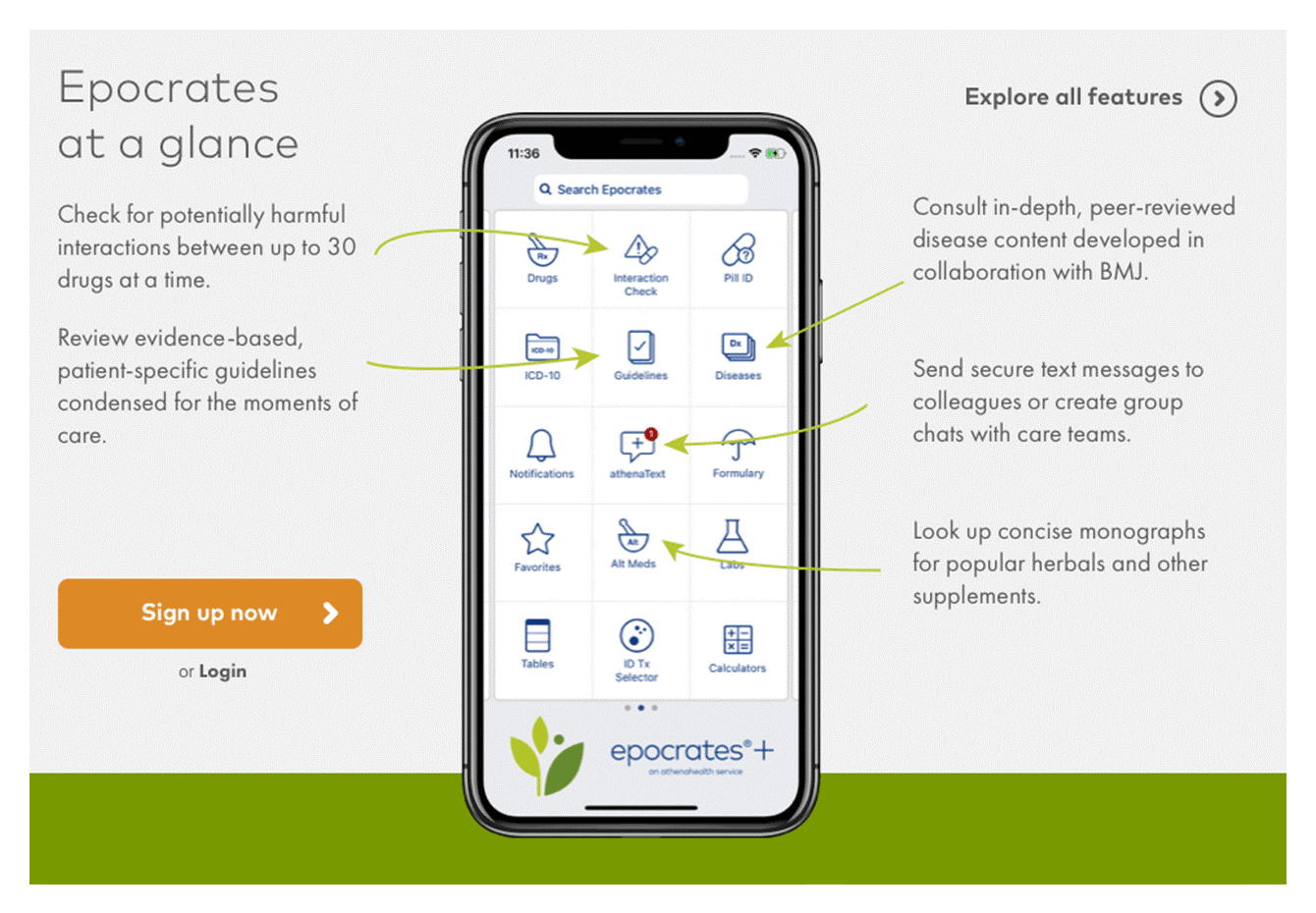
Epocrates
(Image Source: EPOCRATES.COM)
Doctors’ work is always complicated. It requires diagnosing, prescribing the right medicines in the precise doses. They often have to make decisions on the go. What does a doctor do if a patient is allergic to a particular drug? What are the doses of the new pills? Millions of doctors worldwide who downloaded Epocrates can use the app to look up the compatibility of medicines, calculate doses, and search for alternatives for free. Other functions of the app include access to guidelines or patient-specific recommendations, safety recommendations on thousands of drugs, verification and identification of drugs by pill ID, and updates on the latest news in the medical industry. For the most curious physicians, there is Epocrates Plus paid subscription, which extends the content.
Matthew Fisher, attorney at Mirick O’Connell, a Massachusetts-based law firm, spoke to Electronic Health Reporter during HIMSS19, following the release of a new proposed rule by HHS. The proposed rule outlines potential sanctions and penalties placed upon healthcare organizations and physicians that keep information from patients, known as information blocking.
In her explanation of the rule, Administrator Seema Verma took a strong tone in supporting patient access to their health information and ownership of patient data. “One thing that I want to make very clear for the entire healthcare system is that the data belongs to the patient. It’s their data. It doesn’t belong to the provider. It doesn’t belong to the EHR company. It belongs the patient.”
Based on these sentiments and the proposed rule, here Fisher speaks about what it ultimately may define, and its potential impact on providers and healthcare organizations. Listen to our full conversation here:
The essential purpose of virtual reality or VR is to shut down the real world and immerse a person into a different environment, be it a fantasy or just a place far away. While it is mostly used in entertainment, this technology gets wide adoption across other industries, including construction, education, retail and healthcare.
According to a recent report, the global healthcare VR market is expected to massively grow by 2023 with a 54.5 percent CAGR. The researchers name a range of major VR applications anticipated to drive even more investments in upcoming years, including PTSD treatment, rehabilitation, education and training, and surgery simulation. The actively growing market creates a supportive environment for better collaboration among payers, clinical stakeholders, and varied VR development companies, naming Osso VR, Iflexion, Psious and others.
Even though the VR technology is quite young, and healthcare isn’t always daring to adopt cutting-edge approaches and add them to the traditional practice, it is just too promising to ignore.
On the one hand, there are multiple scientific papers debating over virtual reality’s use in pain and anxiety management, mental health improvement, fall prevention in elder population and eye microsurgery training, among the others. On the other hand, we witness market-ready products encouraging health specialists to revolutionize care delivery. In this article, we will review the most promising VR applications in healthcare, backed by real-world solutions.
It’s an understatement to say that AI and machine learning were among the forefront of conversation drivers recently at HIMSS19 in Orlando. One session actually diving into the ethics of AI while leaders from Microsoft, the American Medical Association and the Cleveland Clinic spoke of the need for organizations to develop the right framework for innovative clinical delivery.
Hemnant Pathak, associate general counsel at Microsoft, led the round table discussion, which included Peter Lee, CVP AI and research at Microsoft; Dr. Susanna Rose, Phd., chief experience officer at the Cleveland Clinic; and Sylvia Trujilo, MPP, JD, senior Washington counsel for the American Medical Association.
Virtually every industry is being sharpened by the emergence of these new technologies, Pathak said during his opening remarks, while pointing out the prevalence of the technology throughout the HIMSS exhibition hall. “In many cases, existing frameworks can be adapted, but as they continue to improve we’re going to need sources from every sector and they need to be given equal weight for their considerations” to the healthcare landscape.
On Feb. 12, 2019, CMS Administrator Seema Verma held a session with some members of the healthcare media (this reporter attended the session) at HIMSS19 in Orlando in which she previewed her keynote remarks at the conference. During the briefing, and later during the actual keynote, Verma provided insight into the recently released Interoperability Proposed Rule as well as spoke directly about the Center for Medicare and Medicaid Services (CMS)’ efforts for empowering American patients.
During each session, Administrator Verma highlighted specific actions her agency is taking to ensure Americans have access to their medical records in a digital format. She also profiled some of the steps for setting the stage to increase seamless flow of health information, reducing burdens on patients and providers, and fostering innovation in healthcare through the unleashing of data for researcher and care innovation.
The Administrator took a strong tone to support patient access to their health information and ownership of patient data. “One thing that I want to make very clear for the entire healthcare system is that the data belongs to the patient. It’s their data. It doesn’t belong to the provider. It doesn’t belong to the EHR company. It belongs the patient.”


 One of the most popular tech health devices on the market is the