Healthcare providers are under unprecedented strain from rising claim denials, staffing shortages, and mounting margin pressures. To help meet these challenges, AGS Health, a leading provider of tech-enabled RCM solutions and a strategic growth partner to healthcare providers across the U.S., has introduced a new suite of agentic digital workforce solutions powered by AI agents and intelligent automation.
“Labor-intensive processes, fragmented RCM ecosystems, and continuously shifting payer rules have put healthcare finance leaders at a disadvantage,” said Patrice Wolfe, CEO of AGS Health. “CFOs are now dealing with alarming denial trends and significant financial threats that demand new strategies led by a collaborative digital RCM workforce built for scalability and engineered for impact. Through agentic AI, AGS Health empowers healthcare leaders with digital agents that work alongside their teams, taking on autonomous tasks and recommending data-driven next steps to improve decision-making.”
83% of organizations saw claim denials reduced by at least 10%.
68% reported improved net collections.
39% saw cash flow increase by more than 10%.
A New Class of Digital RCM Workforce
“AGS Health is answering the call for change with AI agents that level the playing field for overburdened RCM teams,” said Thomas Thatapudi, CIO of AGS Health. “Our next-generation, AI-infused workforce solutions bring speed, agility, accuracy, and human-like decision-making to critical RCM functions such as eligibility verification, prior authorizations, denials management, and appeals.”
AGS Health was recently recognized with a UiPath AI25 Award for its pioneering use of agentic AI to help healthcare organizations reduce the financial impact of denials. Its digital workforce features AI agents that understand natural language, adapt to changing rules and workflows, and make autonomous decisions to drive measurable business outcomes, including fewer denials and higher clean claim rates.
Key benefits include:
Financial: Faster reimbursement and lower cost-to-collect
Operational: Improved staff efficiency and focus on high-value work
Quality: Fewer errors in coding, data entry, and appeals
The Hybrid Intelligence Advantage
While AI systems can act autonomously, RCM professionals remain central to a successful digital workforce model. Skilled specialists help train and refine the AI, driving strategy while maintaining oversight and accountability.
“Our hybrid intelligence model combines AI’s speed, accuracy, and scalability with human expertise and empathy,” added Thatapudi. “AI agents manage high-volume tasks while professionals handle exceptions and guide continuous improvement. This can be achieved in-house domestically or through our globally distributed workforce model to reduce operating costs and allow for 24/7 production schedules.”
By preparing work, surfacing insights, and managing exceptions, AGS Health’s AI agents empower RCM teams to make smarter, faster decisions without compromising quality.
By Emily Bonham, senior vice president of product management, AGS Health.
In healthcare revenue cycle management (RCM), we’ve long relied on automation systems that process rules-based workflows with limited or no need for complex logic and nuanced judgement. Robotic Process Automation (RPA) has been highly effective at automating repetitive, high-volume tasks such as claim status checks and data entry.
However, its limitations are increasingly apparent. Today’s revenue cycle challenges demand more than just speed and efficiency; they require adaptability, context, and intelligent decision-making.
That’s where agentic AI comes in.
Agentic AI represents a next-generation approach to automation—one that mimics how humans think, make decisions, and interact with systems and people. Unlike RPA, which follows strict, predefined scripts, agentic AI models operate as autonomous agents. They’re context-aware, goal-oriented, and capable of reasoning across complex workflows. For revenue cycle teams under pressure from rising denials, staffing shortages, and shrinking margins, this kind of intelligence isn’t just nice to have—it’s becoming essential.
What Makes Agentic AI Different?
The simplest way to explain agentic AI is to compare it to a seasoned team member—one who not only knows how to complete a task but also when to escalate, adapt, or reprioritize based on changing circumstances. Agentic systems can:
Interpret and act on real-time data from multiple sources
Make decisions without human intervention
Learn from patterns and improve over time
Collaborate with human team members when needed
In practical terms, this means AI can now triage claims, initiate and complete payer calls, route work dynamically, or even autonomously document and code encounters—all with logic and consistency.
Why This Matters for RCM
Healthcare RCM is a perfect candidate for agentic automation because it sits at the intersection of structure and unpredictability. Processes are highly regulated, but real-world conditions vary constantly. Consider these examples:
Accounts receivable: Agentic AI can identify which claims require expert attention and which can be resolved through automation, ensuring staff spend their time where it’s most needed.
Insurance follow-ups: AI agents can navigate payer phone trees, wait on hold, retrieve claim information, and even update the EHR, without tying up human resources.
Denial management: Instead of flagging a denied claim for review, an agentic system can analyze the denial reason, check documentation, and suggest or initiate corrective actions.
These aren’t distant possibilities—they’re already being piloted and implemented in real-world environments.
The Human + Agentic AI Model
It’s important to note that agentic AI is not about replacing people—it’s about augmenting them. The most effective models combine human oversight with AI execution:
Human experts oversee automated workflows, handle edge cases, make nuanced judgment calls, or perform relationship-driven tasks.
AI agents handle high-volume, rule-governed, or low-dollar work with consistency and speed, while equipping staff members with insights and suggested actions.
This hybrid approach doesn’t just improve throughput; it also enhances job satisfaction for teams that no longer spend their days on tedious follow-ups or simple reconciliations.
Getting Started with Agentic AI
For organizations beginning to explore this space, here are a few guiding steps:
Consolidate and clean your data: Fragmented data across EHRs, billing systems, and vendor platforms limits AI effectiveness. Start by creating interoperable, governed data environments.
Identify high-ROI use cases: Look for repeatable processes with moderate complexity and clear financial upside, like denial prediction, prior authorization automation, or A/R follow-ups.
Experiment with short feedback loops: Choose pilots where you can quickly assess ROI and adjust based on results. Don’t aim for perfection—aim for momentum.
Build trust through transparency: Ensure your AI systems are auditable and explainable, especially when financial decisions are being made autonomously.
A Path to Sustainable Margins
Every healthcare leader is being asked to do more with less: deliver care, navigate compliance, and protect financial performance. Those who lead with tech-forward cultures by embracing intelligent automation and prioritizing data cleanliness in their revenue cycle operations are well-positioned to rise to the occasion. In contrast, those who resist innovation due to skepticism or overly protective and risk-averse policies risk falling behind—exposing their financial performance to volatility and long-term disruption.
Agentic AI offers a path forward, not as a magic bullet, but as a powerful tool for reclaiming time, improving accuracy, and aligning resources where they have the most impact.
It’s still early days for agentic AI in healthcare RCM, but the direction is clear. With the right balance of vision and pragmatism, revenue cycle leaders can unlock a new level of operational intelligence and move closer to sustainable, value-driven performance.
Electronic health record (EHR) vendors are accelerating their adoption of artificial intelligence, aiming to enhance clinician workflows, improve patient care, and remain competitive in an evolving healthcare landscape.
Leaders including Epic and Oracle are integrating AI-driven capabilities into their platforms to help alleviate administrative burdens and boost productivity in an industry grappling with rising costs and clinician burnout.
The move signals a pivotal shift in the role of EHR systems, which have long been criticized by healthcare professionals for their complexity and time-consuming documentation requirements. By leveraging AI, vendors seek to modernize digital health records and make them more intuitive, efficient, and beneficial for both providers and patients.
Addressing Clinician Pain Points
Healthcare professionals often cite EHRs as a source of frustration due to their intricate interfaces and excessive data entry demands. While these systems were originally implemented to digitize and streamline medical documentation, they have frequently been viewed as more of a bureaucratic necessity than a tool designed to support clinical decision-making.
Leigh Burchell, chair of the Electronic Health Records Association, told Healthcare Dive of the need for AI to alleviate administrative strain rather than replace physicians. “Doctors are not looking for AI to act as a doctor or step into their place. They want help with administrative burdens—tasks that take time after a visit to document—so they can focus on patient care,” Burchell explains.
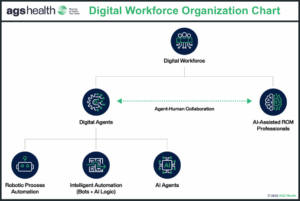 Healthcare providers are under unprecedented strain from rising claim denials, staffing shortages, and mounting margin pressures. To help meet these challenges, AGS Health, a leading provider of tech-enabled RCM solutions and a strategic growth partner to healthcare providers across the U.S., has introduced a new suite of agentic digital workforce solutions powered by AI agents and intelligent automation.
 Electronic health record (EHR) vendors are accelerating their adoption of artificial intelligence, aiming to enhance clinician workflows, improve patient care, and remain competitive in an evolving healthcare landscape.